Life Alert Medical Alert System Price and Value in 2026
Life Alert is a name you can trust, but their prices are fairly high, starting at $49.95 per month with hefty installation fees.


How We Reviewed and Tested Life Alert
Our team of senior tech experts spent over 50 hours evaluating several key factors users should consider when shopping for a medical alert system. We test every system ourselves and consider device durability, price, buying experience, accuracy, and overall value to give readers insights based on our hands-on evaluation of Life Alert’s products. We also ask for feedback from older adults on the systems whenever possible. We then use all our research and personal experience with the products to give each company a rating out of five, so our readers can easily compare systems.
For a closer look at how we test medical alert systems, here’s some more information on the factors we consider.
- Price: Because older adults have varying budgets, we strive to find reliable options that fit every budget.
- Value: We consider not only the price, but also the overall value of each system, as well as whether the features and capabilities justify the price. That includes looking at basic systems and available add-ons.
- Emergency-response times: We also test how well each system responds to medical alerts, conducting several tests to measure average response times. When running the tests, we also measure the consistency and overall quality of the response we get from monitoring agents.
- Ease of use: We like high-tech systems, but overly complicated ones can compromise users’ safety. That’s why we ensure every function is accessible and easy to use, even for older adults who are less tech-savvy.
- Purchasing experience: In addition to ease of use, we test how easy it is to find and purchase a suitable system from the company. We look at how much information is available on the company’s website, and we speak with customer-service representatives to gauge their helpfulness.
- Equipment: Once we have the systems, we test the equipment for its quality, durability, and reliability. We run the tests at home for in-home systems and on the go for mobile systems. We also do fall-detection tests.
- Features and add-ons: We look at the available optional features, such as vanity pendants, fall detection, and caregiver apps. We also gauge if they are worth the additional price.

Compared to the best medical alert systems of 2026, Life Alert's rates are expensive. The average Life Alert cost per month ranges from $49.95 to $89.95, not including additional Life Alert fees, like installation. That's about $25 to $40 per month higher than the industry average.
That said, as an industry leader since 1987, Life Alert is one of the most recognizable medical alert system providers in the United States. Most people are familiar with the name, or at least their memorable commercials. In an industry full of new brands and services, a familiar name with nearly four decades of experience goes a long way. However, the cost of Life Alert still far exceeds most of the competition.
Life Alert offers impressive monitoring services and reliable equipment, though. If you’re looking for the peace of mind that comes with a company backed by decades of experience, Life Alert is a viable option, as we discovered after testing its systems. We’ll get into all the details of Life Alert’s products and value, including pricing and money-saving tips.

Life Alert at a Glance
- An industry leader since 1987
- Response times of 15 to 20 seconds
- Company-owned dispatch center
- Professional installation
- Prices ranging from $49.95 to $89.95 per month
- Three-year contracts
- In-home and on-the-go systems
The Fast Facts: Life Alert’s Equipment and Pricing
| Product | Function | Price | Features |
|---|---|---|---|
| Master Unit | In-home system |
|
|
| Mobile + GPS | Add-on: On-the-go monitoring device | $20 per month** |
|
| Help Button | Add-on: Emergency alert device | $20 per month** |
|
*Master Unit must be bundled with add-on devices in most cases.
**Device can’t be purchased as a stand-alone system. It must be bundled with the Master Unit.
Life Alert Costs vs. Other Top Medical Alert Brands
| Provider | Upfront fees | Monthly monitoring | Year 1 total (fees + 12 months) | Year 3 total
(fees + 36 months) |
Contract | Best fit for |
|---|---|---|---|---|---|---|
| Life Alert | $197 delivery and installation | $49.95 to $89.95 | $796.40 to $1,276.40 | $1,995.20 to $3,435.20 | Three-year contract required | Those who want a well-known brand and don’t mind a longer contract |
| Bay Alarm Medical | $0 to $199 equipment fees | $27.95 to $64.95 | $335.40 to $978.40 | $1,006.20 to $2,537.20 | No long-term contract required | Thosewho want affordable home monitoring with optional add-ons |
| Medical Guardian | $0 to $199.95 equipment fees | $31.95 to $46.95 | $383.40 to $763.35 | $1,150.20 to $1,890.15 | No long-term contract required | Those who want lots of device options and feature-rich systems |
| MobileHelp | None | $25.95 to $49.95 | $311.40 to $599.40 | $934.20 to $1,798.20 | No long-term contract required | Couples and seniors on a tight budget |
Looking for a More Affordable System? Check Out These Quality Alternatives
Life Alert is one of the most trusted names in medical alert systems, but there are several more affordable options with newer tech. When shopping for a medical alert system, consider your needs and budget. You should never take risks with your health, but you also shouldn’t pay for equipment or services you don’t need. If you’re not set on Life Alert, here are a few of the best alternatives we have reviewed.



A Closer Look at Life Alert’s Systems and Value
Life Alert offers one main system, the Master Unit, and two add-on devices: the Mobile + GPS unit and the Help Button. Unlike most medical alert providers, which have stand-alone systems, Life Alert typically requires customers to bundle their products together.
Every customer is required to purchase the Master Unit, and it must be bundled with one of the add-on devices for $69.95 per month or both for $89.95 per month. In select cases, you can purchase the Master Unit on its own for $49.95 per month, but you’ll need to get special approval from a Life Alert representative to get this plan.
The Installation Process
Life Alert’s $197 delivery and installation fee is meant to cover more than just “turning the system on.” It pays for a professional setup and handoff, so equipment is ready to use immediately, and so you (or a caregiver) know exactly what to do in an emergency.
Here’s what that fee generally includes:
- Professional setup and activation: The installer gets the base unit and help buttons set up correctly, confirms the system is activated, and makes sure the connection method (landline or cellular) is working.
- Equipment testing: They run at least one test call and verify that the alert center receives the signal, can hear you clearly, and can follow the response process from start to finish.
- User training: A quick “how-to” walkthrough so you know how to wear and use the button, what happens when you press it, how the speaker works, and what to do if the alert was triggered by mistake. This is especially helpful for older adults who don’t want to troubleshoot the system on their own.
- Account and warranty registration: Setup includes confirming your subscriber details (including medical notes and entry instructions), and ensuring the system is properly registered for service and warranty coverage.
- Placement guidance: The installer can recommend where to place equipment in your home and how to position help buttons for real-life use.
While Life Alert’s delivery and installation fee is higher than any other we’ve seen, the benefits of getting a professional installation help may justify the cost for some users. With medical alert systems, you don’t want to wait until there’s an emergency to discover weak signal coverage, unclear audio, or that you don’t feel confident using the button. However, medical alert setup is very simple and there are plenty of resources to help users set things up correctly, so we don’t think this installtion fee is worth it for many people.
The Master Unit
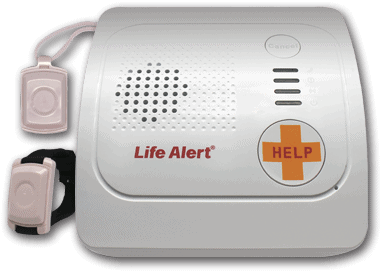
Life Alert Base Unit and Wearables
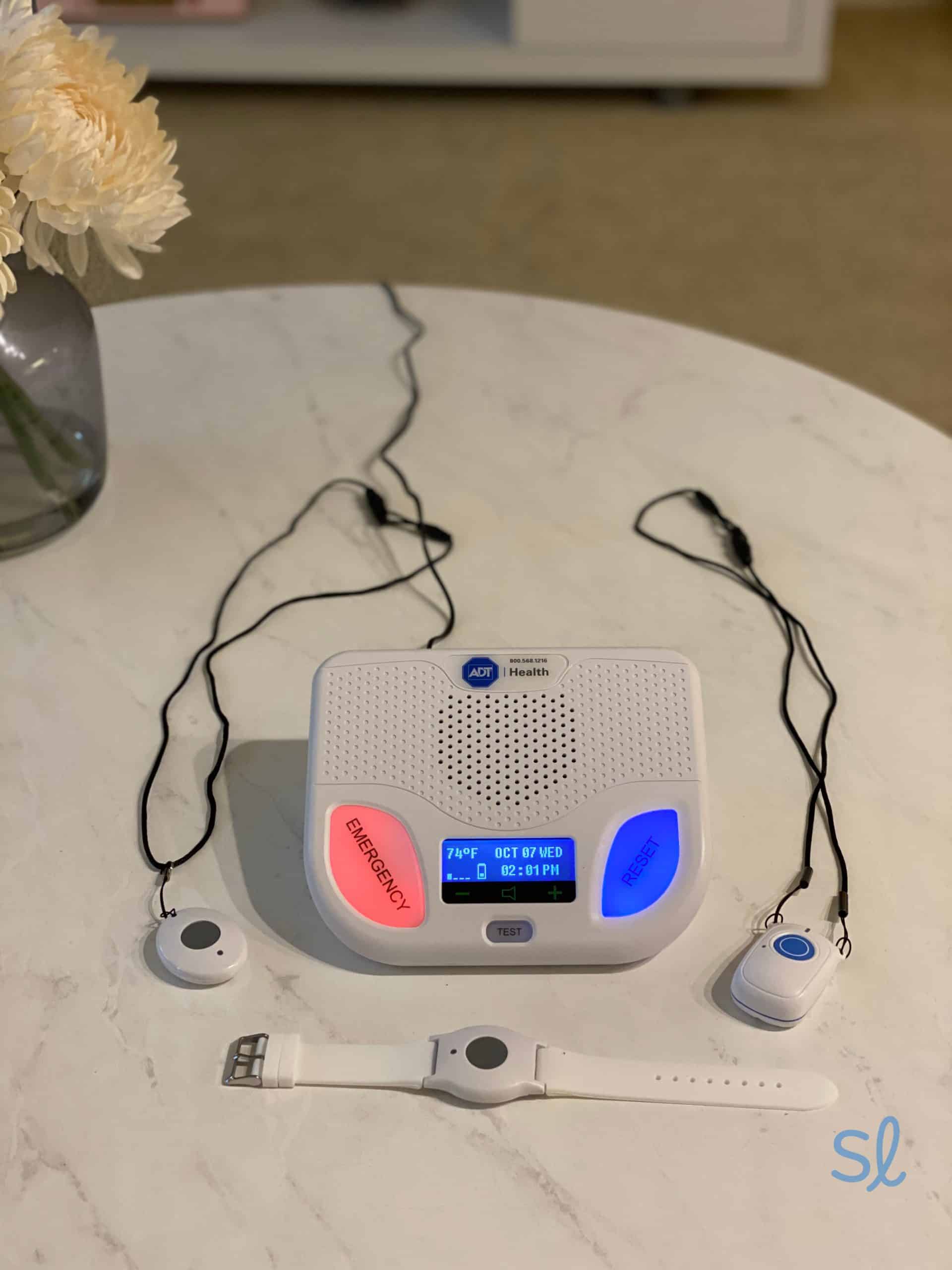
The Master Unit is Life Alert’s standard, in-home system featuring a base unit and a pendant. It costs $49.95 per month on its own, but most customers are required to bundle it with one or both of Life Alert’s add-on devices. Bundles start at $20 more per month, so you’ll get more value when you bundle instead of purchasing the Master Unit on its own.
The base unit has an emergency button, a two-way speaker, and a 72-hour backup battery. The pendant, which can be worn around the neck or wrist, is waterproof, so you can wear it in the shower or bath. It also features a 10-year battery — no charging required! The pendant has a good signal range of 800 feet from the base unit (for comparison, LifeFone’s range is 600 feet, but it does not have automatic fall detection.
FYI: The biggest contributors to falls among older adults are lower-body weakness, vitamin D deficiency, and taking medications such as sedatives and antidepressants, according to the Centers for Disease Control and Prevention.1
Add-on Accessories: Pricing and Features
You'll typically have to bundle Life Alert's Master Unit with one or both of its add-ons. So you'll need to decide: Do you want an on-the-go unit, a wall button, or both with your in-home system? Life Alert's fees will vary based on this choice.
Mobile + GPS

Life Alert Mobile + GPS
Life Alert’s Mobile + GPS device is a good option for those who want to take Life Alert’s monitoring on the go. It costs $20 per month to add the Mobile + GPS device to your Master Unit, which is around $20 to $30 cheaper than Medical Guardian’s monthly rates and Medical Alert’s prices for on-the-go systems. It will work wherever a GSM cell phone is available. Unlike their competitors, who rely on a single big-name carrier such as AT&T or Verizon, Life Alert utilizes service from multiple carriers, so their system offers great coverage almost everywhere.
The device’s battery lasts for 10 years and doesn’t require a charge. On-the-go GPS units from other companies we’ve reviewed, such as MobileHelp, have batteries that last half that long. The Mobile + GPS device can be worn or carried anywhere, whether as a necklace, in a pocket, or on a belt clip. During an emergency, just press the help button on the unit and use the built-in speaker to communicate with a live operator. Thanks to GPS technology, Life Alert will pinpoint your exact location and send help quickly.
The Help Button
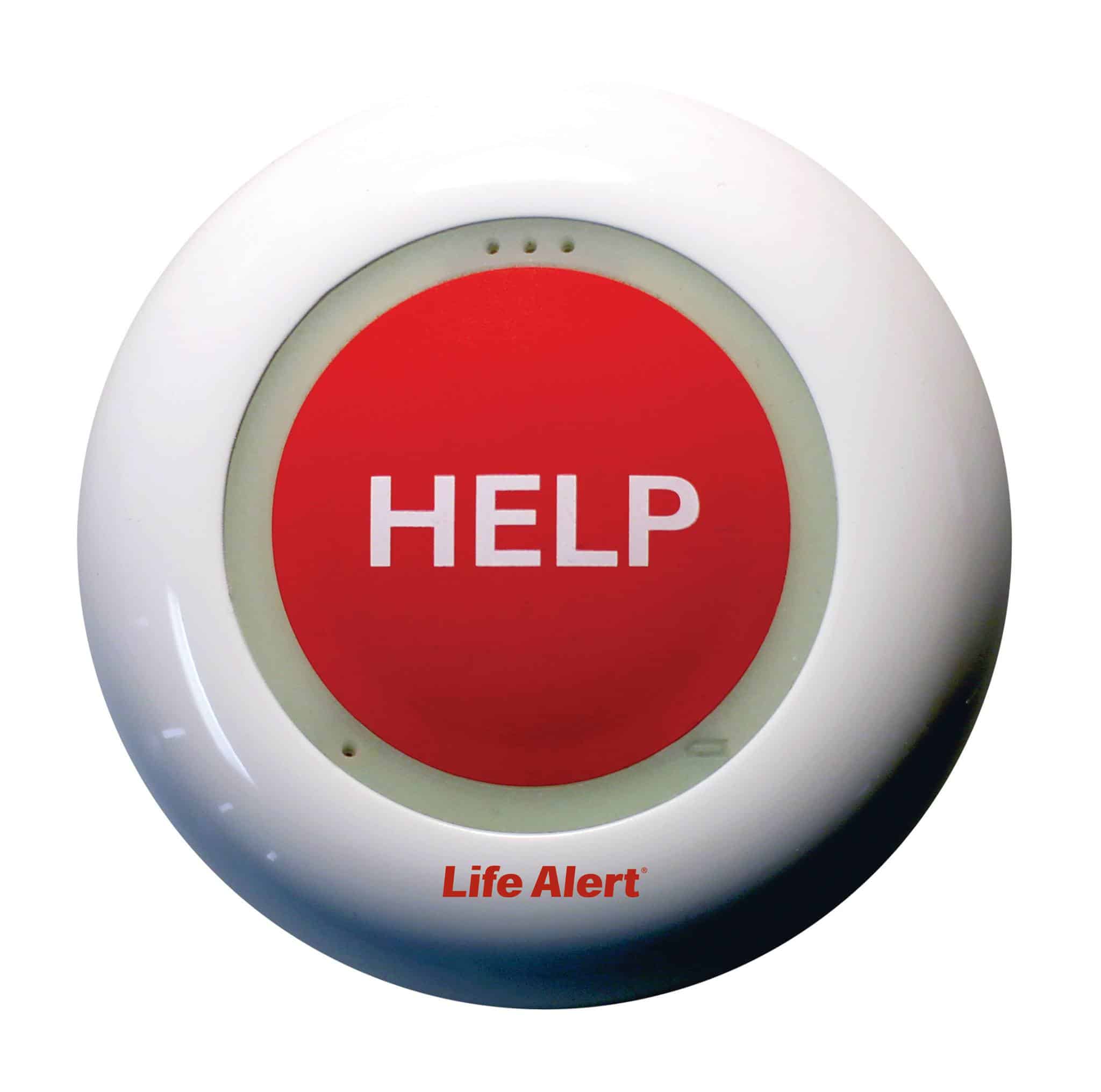
Life Alert Help Button
The Help Button is one of our favorite Life Alert add-on devices. It’s a waterproof red button with a two-way speaker. Other competitors offer emergency button add-on devices, but not many have two-way speaker capabilities.
The adhesive allows you to place it anywhere it’s needed, and the battery lasts up to 10 years. Thanks to the waterproof design, it’s ideal for places where falls are more likely to happen, especially in the shower. Bundling the Help Button with your Master Unit and the Mobile + GPS device will give you the most well-rounded Life Alert package for complete protection.
FYI: Falls are the leading cause of injury for people 65 and older in the U.S., and 1 in 4 older adults report a fall every year, according to the Centers for Disease Control and Prevention.2
Life Alert Contract Explained
Life Alert requires a 36-month (three-year) monitoring agreement before you can move to a more flexible billing arrangement.
The contract is more strict than most medical alert providers, and early cancellation is usually limited to specific circumstances (like moving into a nursing home or requiring round-the-clock care), depending on the terms you signed and the documentation you provide. For this reason, we highly recommend considering other medical alert providers before purchasing.
If you cancel outside of the situations allowed in your original agreement, Life Alert will likely treat it as early termination and require additional payments. In a New York Attorney General agreement describing past contracting practices, consumers reported being told they would need to pay for the additional months remaining to cancel (as much as six months, in some cases).
Pro Tip: Before you sign, ask the representative to put in writing: 1) when early cancellation is permitted, and 2) exactly what you’d owe if you cancel early.
What Happens After Three Years?
After the initial 36-month term, the Monitoring Service Agreement automatically renews on a month-to-month basis, unless you cancel under the contract’s rules. This generally means being able to cancel with 30 days’ notice.
For example, if you cancel one day before your three-year contract ends, you may still have to pay for that additional month of service, after which time your agreement will be cancelled, and you won’t pay anything else.
How to Cancel Life Alert
If you know you don’t want to continue your service, it’s best to contact Life Alert as soon as possible to avoid additional costs. Let the representative know (at least 30 days prior to the contract’s end) that you don’t want automatic renewal to occur and make get confirmation of your cancellation notice in writing.
If you’re cancelling due to a qualifying event (like entering a care facility), provide the documentation they request. Once the cancellation is confirmed in writing, return all Life Alert equipment within 30 days of termination. Failing to send back all equipment or accessories, or sending them back after the 30-day deadline, could result in penalty fees.
Does Life Alert Offer Refunds?
Since Life Alert doesn’t offer a standard free trial period, many customers want to know how (or if) they can get their money back. Since individual agreement terms can vary, particularly as they pertain to state-specific cancellation rights, the answer may not be the same for everyone.
That said, upfront fees (like Life Alert’s $197 delivery and installation fee) are generally non-refundable. Life Alert allows for family members to request a refund if the subscriber passes away during the contract term, but this refund only applies to any prepaid monitoring fees. It’s important to always get the refund policy in writing at the time of purchase.
How to Save Money on Life Alert
Life Alert is one of the pricer medical alert systems, and during our research, we didn’t find any official discounts or promotions. Still, it’s worth going into the signup call ready to ask for savings. Here are the most realistic ways to lower your total cost.
1. Ask directly about military, AARP, and other affinity discounts
Life Alert doesn’t always advertise discounts publicly, but promos and “unpublished” offers can change. When you call, ask the representative:
- “Do you have special pricing for veterans?”
- “Do you offer a discount for AARP members? Or any partner discount?”
- “Are there any discounts for first responders, teachers, or senior organizations?”
Also ask if there are any limited-time promotions running. Life Alert has advertised incentives like “one month free” on its site at times, so it’s smart to confirm what’s active when you enroll.
2. Try to negotiate or reduce the installation fee
Since Life Alert’s one-time installation fee greatly increases your upfront costs, ask if they can:
- Waive (or reduce) the installation fee
- Offer a credit equal to the installation fee
- Apply a promo (like a free month) toward that upfront cost
A simple way to frame things that can increase your chances of success: “I’m comparing a few different providers today. If you can reduce the $197 installation fee, I can sign up now.”
3. Bundle devices instead of adding them later
Life Alert’s pricing increases as you add devices. If you already know you’ll want multiple help buttons, for example, Mobile + GPS and the Help Button, ask about:
- The cheapest bundle for your home layout
- Whether adding devices later costs more than bundling at signup
- Any bundle promos that include free accessories or reduced fees
To get the most bang for your buck, we'd recommend bundling the Master Unit with the Mobile + GPS unit and Help Button, if your budget allows. It will cost you $20 per add-on. Many mobile units from other providers cost $30 to $40 on their own, so you'll basically be getting both add-ons for the price of one mobile unit. The total cost ($89.95 per month) is pretty steep, however, so it may not be ideal for older adults on a fixed income.
Pro Tip: Not sure what a healthy weight for you is as you age? Seniors need fewer calories, but the same amount of nutrients. Visit the NIH’s National Institute of Diabetes and Digestive and Kidney Diseases to learn more about nutrient-dense foods.3
Will Medicare or Private Insurance Cover Life Alert?
In most cases, Original Medicare will not cover medical alert systems from any provider because these systems are not treated as durable medical equipment. Some Medicare Advantage (Part C) plans may offer an allowance or partial coverage as an extra benefit, so it’s worth calling your plan provider to ask what’s included.
Even when Medicare doesn’t pay, many medical alert systems can be HSA or FSA-eligible as a qualified medical expense, meaning you may be able to use pre-tax account funds to cover all or part of the cost.
Finally, some seniors can get help through state Medicaid Home and Community-Based Services (HCBS) waiver programs, which may cover a personal emergency response system (PERS) to support aging in place. Coverage and eligibility vary widely by state.
Compare Life Alert to Other Providers

Is Life Alert Right for Me?
Here are some questions to help you determine whether or not Life Alert is right for you.
Does Life Alert fit in your budget?
That is probably the most critical factor to consider, because Life Alert’s services are on the pricier side. Bundles range in price from $69.95 to $89.95 per month, depending on the package. Remember that there is a one-time shipping and installation fee of $197 per package, which is one of the highest installation fees we’ve seen.
Do you need fall detection or other add-ons?
All of Life Alert’s devices have essential features such as long-lasting batteries and two-way speakers, but don’t currently offer extra features like fall detection, jewelry pendants, or activity tracking. If you’re looking for those bells and whistles, check out Bay Alarm Medical packages or read our Aloe Care Health review.
Are you willing to sign a three-year contract?
All new Life Alert customers must sign a three-year contract. Month-to-month plans become available after the initial three years, but Life Alert may not be the right choice for you if you’re looking to avoid a long-term contract.
Did You Know? According to Life Alert, the company’s systems save a life every 11 minutes.
Life Alert vs. the Competition
Life Alert leads the pack in name recognition among medical alert systems, but they are also among the most expensive systems. Other companies, such as MobileHelp, offer similar products for much cheaper. MobileHelp systems start at $25.95, while LifeFone starts at $24.95.
Life Alert devices are not the most high-tech, either, but we appreciate the steps they've taken to modernize, such as the introduction of the Micro Voice Pendant. We were also impressed with the sturdiness of their Help Buttons, which come equipped with two-way speakers.
The ability to communicate with operators even if you’re not wearing your alert device in an emergency is a huge plus. We noted in some of our tests that it sometimes took two full minutes for an agent to respond to our alert, which is a concerning delay. In some tests, however, agents responded much faster.
Life Alert also does not offer a free trial period to test their products, unlike the LifeStation system we tested or Bay Alarm Medical’s systems. LifeStation’s devices work within a shorter range (600 feet) than Life Alert’s, but the new Micro Voice Pendant works within 1,000 feet of the base unit. If your home is large, consider researching base units with a much broader range, such as MobileHelp. The company says their devices work up to 1,400 feet from the base unit.
Life Alert Alternatives for Budget-Conscious Buyers
Here are a few of the best alternatives to Life Alert that you can get for under $30 a month:
- Bay Alarm Medical’s SOS Home (Landline): Starting at $27.95 per month with no equipment or activation fees, this system is best for seniors who want a simple, affordable, in-home setup. You can add optional fall detection, unlike Life Alert. Just keep in mind that you won’t get the professional installation Life Alert offers.
- MobileHelp Classic: Starting at $25.95 per month (with zero equipment fees), MobileHelp’s Classic system is great for budget shoppers searching for in-home monitoring. Like Bay Alarm Medical, you won’t get professional installation, but you will get access to “extras” like a caregiver app and paid fall detection.
- Medical Guardian’s MGHome Landline. If you’re willing to pay for at least three months of service in advance, you can get Medical Guardian’s MGHome Landline system for $29.95 per month (quarterly) or $27.95 per month (annually), and the $149.95 equipment fee is often waived. Standard monthly pricing is $31.95. Once again, you won’t get the professional installation services of Life Alert, but you will have access to a ton of paid extras, like fall detection and OnGuard Alerts.
Final Thoughts on Life Alert’s Pricing and Value
With nearly 40 years of experience and one of the most recognizable names in the industry, Life Alert offers peace of mind to older adults and their families. Their monthly rates and installation fees are very high, and a three-year contract is required, but Life Alert is a solid option for simple, reliable protection. You’ll be able to count on the devices for years to come, so Life Alert is worth considering if it fits your budget. Read our 2026 Life Alert review to learn more about the provider.
Check out our hands-on video review of Life Alert’s systems below for a closer look.
Frequently Asked Questions About Life Alert
-
Is Life Alert waterproof?
The Life Alert pendant and Help Button are waterproof, perfect for use in the shower or tub.
-
What is the return policy for Life Alert?
A customer-service representative informed me that you can return your system if you’ve cancelled your service under the terms of the agreement, or in the event of a death. You typically have 30-days from cancellation to return your equipment penalty-free.
-
Do you have to have internet for Life Alert?
No, Life Alert’s base unit does not require Wi-Fi to connect to emergency response agents.
-
Centers for Disease Control and Prevention. (2024). Facts About Falls.
-
Attorney General of the State of New York. (2021). Assurance of Discontinuance No. 21-021.
-
National Institutes of Health. (2019). Health Tips for Older Adults.