Inogen vs. CAIRE Oxygen Concentrator Comparison Guide
Inogen is our pick for lightweight travel, while CAIRE is our choice for continuous flow. Here's how to decide which matters more for you.
SeniorLiving.org is supported by commissions from providers listed on our site. Read our Editorial Guidelines
Choosing a portable oxygen concentrator is one of the more consequential medical equipment decisions an older adult or caregiver will face. Two brands come up more than any other in that conversation: Inogen and CAIRE. Both companies have deep roots in respiratory care and strong reputations among prescribers and patients — but they're built around different priorities.
Inogen's reputation rests on being the lightest, most travel-friendly pulse dose concentrators available. CAIRE's strength lies in clinical versatility, including smart delivery technology on the FreeStyle Comfort and the Eclipse 5's unique ability to deliver both continuous flow and pulse dose in a single portable unit. We compared both brands on specs, pricing, apps, warranties, and buying experience. Here's what we found.
FYI: Systems from Inogen and CAIRE made it on our list of the best oxygen concentrators in 2026!
How We Compared These Brands
We evaluated Inogen and CAIRE using a consistent framework: device specifications, oxygen delivery type, portability, battery life, noise level, warranty coverage, app features, pricing transparency, and buying experience. We reviewed manufacturer specifications, authorized dealer information, warranty details, and product documentation.
We also considered the kinds of real-world questions older adults and caregivers ask when comparing portable oxygen concentrators: Is it light enough to carry? Can it handle my prescription? How long will the battery last away from home? What happens if it needs service? And how easy is it to buy or return?
Our recommendations are based on product fit, prescription needs, portability, cost, and ease of use.
Brand Overviews
Inogen, headquartered in California, has focused almost exclusively on lightweight pulse dose portable concentrators since 2001. Their current portable lineup — the Rove 4 and Rove 6 — reflects that engineering philosophy: both are under 5 lbs, both are FAA-approved, and both sell directly to consumers with transparent pricing and a trial option.1
CAIRE, based in Ball Ground, Georgia, brings over 50 years of respiratory equipment experience and a broader product philosophy. Their portable lineup spans the lightweight, wearable FreeStyle Comfort and the cart-based Eclipse 5 — the latter being one of the only portables on the market that deliver genuine continuous flow oxygen alongside pulse dose. CAIRE was also the first manufacturer to offer a 3-year warranty covering both the device and its sieve beds.2
Quick Highlights
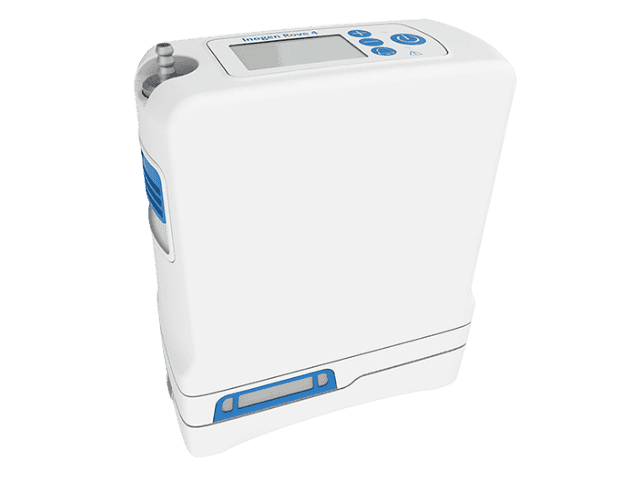
- Inogen is best for lightweight travel. The Rove 4 weighs 2.9 pounds with the standard battery, making it the lighter choice for seniors who want the easiest device to carry.
- CAIRE is best for continuous flow needs. The Eclipse 5 offers both pulse dose and continuous flow oxygen, while Inogen’s portable devices are pulse dose only.
- CAIRE FreeStyle Comfort has the longest wearable battery life. With the 16-cell battery, it can run up to 16 hours, compared to the Rove 6’s 12 hours and 45 minutes with the extended battery.
- Inogen is easier to shop for online. Inogen publishes direct prices and offers a 30-day risk-free trial on select models, while CAIRE pricing is quote-based through dealers.
- Start with your prescription. If your doctor prescribed continuous flow, CAIRE is the better fit. If you use pulse dose and prioritize travel, Inogen is likely the better choice.
>> Learn More: A Guide to Portable Oxygen
Product Comparison
| Device | Brand | Type | Weight | Max Output | Max Battery | Approx. Price |
|---|---|---|---|---|---|---|
| Rove 4 | Inogen | Pulse dose | 2.9 lbs | 840 mL/min | 6 hrs 7 min (ext.) | Starting at $2,695 |
| Rove 6 | Inogen | Pulse dose | 4.8 lbs | 1,260 mL/min | 12 hrs 45 min (ext.) | Starting at $2,795 |
| FreeStyle Comfort | CAIRE | Pulse dose | 5 lbs with 8-cell battery; 6 lbs with 16-cell battery | 1,050 mL/min | 16 hrs (16-cell) | Dealer quote-based; often $2,500-$3,000+ |
| Eclipse 5 | CAIRE | Pulse + continuous | 18.4 lbs with battery and cart | 3.0 LPM (CF) | 5.4 hrs at pulse setting 2; 2 hrs at 2 LPM continuous flow | Dealer quote-based; often $3,000+ |
The most important difference in this table is not just weight or battery life. It is oxygen delivery type. Inogen’s current portable lineup is pulse dose only, which works well for many active seniors but is not appropriate for every prescription.
CAIRE offers both lightweight pulse dose portability with the FreeStyle Comfort and continuous flow flexibility with the Eclipse 5. That makes CAIRE the stronger choice for seniors whose oxygen needs may change or who have been prescribed continuous flow.
>> Know Your Options: Does Medicare Cover Portable Oxygen Concentrators?
Feature and Pricing Comparison
Weight and Portability
The Inogen Rove 4 is the lightest 4-setting portable oxygen concentrator on the market at 2.9 lbs, and the Rove 6 weighs 4.8 lbs with its standard battery.
For older adults with limited upper-body strength or who use a walker, that difference from CAIRE’s FreeStyle Comfort's 5 (or 6) lbs is real. The Eclipse 5 at 18.4 lbs is a fundamentally different category — a rolling cart device, not a wearable one. Inogen wins on weight.
From a caregiver’s perspective, this weight gap matters most during repeated daily use. A 2.9-pound device may feel manageable for a quick appointment, while a 5- or 6-pound device can become tiring if someone is also carrying a purse, using a cane, or managing medications and paperwork.
>> Our Provider Review: Inogen Review and Pricing
Smart Delivery Technology
Both brands use proprietary breath-sensing systems, but CAIRE's FreeStyle Comfort goes further with autoSAT. The autoSAT technology actively adjusts the oxygen bolus volume per breath as breathing rate changes during activity, and was clinically shown to deliver statistically significantly higher FiO₂ at elevated breathing rates of 30–40 breaths per minute compared to standard pulse dose delivery.
Inogen's Intelligent Delivery Technology® times delivery to inhalation but delivers a fixed bolus per setting. CAIRE wins on adaptive delivery during exertion.
>> Check Out: Changes in Health and Health Care as We Age
Continuous Flow
This is the clearest differentiator. The Eclipse 5 is CAIRE's proven 24/7 single-oxygen solution capable of supporting almost all oxygen users regardless of prescription, delivering continuous flow up to 3 LPM and pulse dose settings 1–9.
Inogen has no portable continuous flow option. CAIRE wins — definitively.
This is also where a doctor’s prescription matters more than brand preference. If a senior needs continuous flow overnight or during higher-demand periods, choosing the lightest pulse dose unit may not solve the actual oxygen need.
Battery Life and Noise
The FreeStyle Comfort edges out the Rove 6 on maximum battery life: 16 hours (16-cell) vs. 12 hours 45 minutes (extended battery). For everyday use, we’d look at battery life less as a “maximum hours” number and more as a planning tool. Longer battery life can mean fewer charging breaks during errands, fewer spare batteries to remember, and less anxiety during appointments that run late.
On noise, both brands are functionally identical — all four devices operate between 39–40 dBa, quieter than a typical refrigerator.
Pricing and Buying Experience
Inogen sells directly to consumers with published starting prices and a 30-day risk-free trial on the Rove 4. Financing through Affirm and HSA/FSA acceptance are available. The Rove 6 starts at approximately $2,795, with the extended battery adding more than $600 to the base cost.
CAIRE does not list prices on its website — pricing is quote-based through authorized dealers or by calling 1-800-482-2473. Both brands price in similar ranges, but Inogen's direct purchase model and transparent starting prices make comparison shopping considerably easier. Inogen wins on pricing transparency and buying accessibility.
This is a big advantage for adult children and caregivers who are helping compare options online. With Inogen, you can see the starting price, warranty options, accessories, and financing before calling. With CAIRE, buyers often need to contact dealers to understand the full package price.
Pro Tip: For either brand, always request quotes from multiple authorized dealers before purchasing. Package pricing varies significantly, and promotional pricing is common.
App, Warranty, and Support
Apps
The Inogen Connect app is free for Rove users and connects via Bluetooth to provide real-time battery status, column monitoring, maintenance tracking, automatic software updates, and error alerts on both iOS and Android. It's a patient-facing tool — useful for independent users and family caregivers managing devices remotely.
CAIRE's myCAIRE is primarily provider-facing, enabling clinicians to remotely monitor patient usage and device data. The FreeStyle Comfort was the first wearable POC to offer wireless connectivity for provider monitoring through CAIRE's telehealth solution.
For independent users, a patient-facing app is most useful when it answers simple daily questions: How much battery is left? Does anything need maintenance? Is there an alert I should pay attention to? For provider-monitored users, CAIRE’s approach may be more helpful because the data can support clinical oversight rather than just personal device management.
Warranty and Support

|

|
|
|---|---|---|
| Standard warranty | 3 years | 3 years (device + sieve beds) |
| Lifetime warranty option | Yes | Dealer-dependent |
| 30-day trial | Yes (Rove 4) | Dealer-dependent |
| Expected service life | Up to 8 years | Minimum 5 years |
| Support channels | Phone, chat, online | Phone (1-800-482-2473) |
| Website |
Get a Free Guide
Links to Inogen.com
|
Both brands offer strong 3-year standard warranties. CAIRE's explicit sieve bed coverage is a meaningful differentiator — replacing sieve beds is typically the most significant maintenance cost in a concentrator's lifespan. Inogen's lifetime warranty upgrade option is a strong long-term value play for patients expecting multi-year dependence on their device.
Pro Tip: If you're purchasing an Inogen device and expect to depend on it for 5+ years, compare the cost of the lifetime warranty upgrade against projected repair costs.
Drawbacks
Inogen's key limitations
Inogen’s biggest limitation is that its portable concentrators are pulse dose only. If your prescription requires continuous flow oxygen, you will need a different portable option or a stationary home concentrator. This is the most important clinical limitation in the Inogen lineup.
The second drawback is accessory cost. The Rove 6’s extended battery is useful for all-day portability, but it adds more than $600 to the base device cost. That matters for seniors paying out of pocket or comparing packages across dealers.
CAIRE's key limitations
CAIRE’s biggest drawback is pricing transparency. Unlike Inogen, CAIRE does not make it as easy to compare direct purchase prices online. Many buyers will need to contact authorized dealers, which can make shopping slower and more confusing.
CAIRE’s other drawback is portability. The FreeStyle Comfort is wearable, but it is heavier than the Rove 4. The Eclipse 5 offers excellent continuous flow versatility, but at 18.4 pounds with the battery and cart, it is more of a transportable unit than a lightweight wearable device.
>> Related Reading: A Guide to Caregiving in Senior Care
Best For
Choose Inogen if…
You are prescribed pulse dose oxygen and want the lightest, simplest option for everyday portability. The Rove 4 is best for seniors who want the lowest possible carrying weight for short errands, appointments, and travel days. The Rove 6 is better for seniors who want more oxygen output, more pulse dose settings, and longer battery life.
Inogen is also the better choice if you prefer direct online shopping, published prices, financing options, and a clearer trial structure.
Choose CAIRE if…
Your oxygen needs are more complex, or if continuous flow may be required. The FreeStyle Comfort is best for seniors who still want a wearable pulse dose device but prefer CAIRE’s adaptive delivery features and longer maximum battery life with the larger battery. The Eclipse 5 is best for seniors who need continuous flow oxygen in a transportable unit that can also support pulse dose.
CAIRE is also a strong fit for patients whose care teams want more provider-side monitoring and clinical oversight.
| Priority | Better Choice |
|---|---|
| Lightest device for short errands and travel | Inogen Rove 4 |
| Longer battery life in a wearable pulse dose device | CAIRE FreeStyle Comfort |
| More pulse dose settings in a lightweight Inogen model | Inogen Rove 6 |
| Continuous flow portability | CAIRE Eclipse 5 |
| Direct online purchase and trial | Inogen |
| Provider-side monitoring | CAIRE |
| Lowest carrying weight | Inogen |
| Most prescription flexibility | CAIRE |
Final Thoughts
Inogen and CAIRE are both strong oxygen concentrator brands, but they solve different problems. Inogen is the better fit for seniors who use pulse dose oxygen and want a lightweight, travel-friendly device with a more straightforward buying process. The Rove 4 is especially appealing for those who want the lightest option, while the Rove 6 offers more output and longer battery life.
CAIRE is the better fit for seniors who need more clinical flexibility. The FreeStyle Comfort is a strong wearable pulse dose option with long battery life, while the Eclipse 5 is the better choice for people who need continuous flow in a transportable concentrator.
The safest way to choose is to start with your prescription, then match the device to your lifestyle. If you need continuous flow, CAIRE is the clear winner. If you use pulse dose and want the easiest device to carry, Inogen is hard to beat.
FAQs
-
Can Inogen portable devices deliver continuous flow oxygen?
No — all Inogen portables are pulse dose only. For continuous flow needs, Inogen offers home concentrators as stationary solutions, but no portable continuous flow device currently exists in their lineup.
-
Which brand is better for air travel?
Both brands offer FAA-compliant portables, but Inogen’s Rove 4 at 2.9 lbs is the lightest option and fits easily under an airline seat. Both require advance airline notification and the FAA’s 150% battery rule applies to both.
-
Does CAIRE offer a trial period?
CAIRE does not offer a standard consumer trial through its website. Return and trial policies are set by individual authorized dealers, so buyers should confirm terms before purchasing.
-
Is CAIRE's sieve bed warranty unique?
CAIRE was the first manufacturer to offer a 3-year warranty covering both the device and its sieve beds — the core oxygen-producing components. Most competitors’ standard warranties don’t explicitly include sieve bed coverage.
-
Does Medicare cover either brand?
Both brands may qualify for Medicare Part B coverage as durable medical equipment when medical necessity criteria are met.3 Coverage is processed through Medicare-approved DME suppliers — contact your insurer or an authorized dealer to verify eligibility before purchasing.
-
Inogen. (2026). Inogen Rove 4 Portable Oxygen Concentrator.
-
CAIRE. (n.d.). Freestyle Comfort.
-
Medicare. (n.d.). Oxygen equipment & accessories.