Inogen Review and Pricing
Inogen stands out for its lightweight, travel-friendly oxygen concentrators with long battery life and strong reliability, though higher upfront costs for portable units are important considerations for many users.



If someone you love has been prescribed supplemental oxygen, or if you’re navigating that road yourself, it can feel overwhelming. Between the medical terminology, the equipment choices, and the price tags, there’s a lot to take in. This guide walks through one of the most trusted names in the space: Inogen. You’ll find everything you need to know about their products, what they cost, who they’re best for, and what to watch out for.
Inogen was founded by a group of University of California students who wanted to build a better oxygen solution for one of their grandmothers diagnosed with COPD. That origin story says something about the company’s DNA: they built this for someone they loved, not just for a market opportunity. Over two decades later, Inogen is a publicly traded company (NASDAQ: INGN) with an A+ rating from the Better Business Bureau1 and accreditation from the Accreditation Commission for Health Care.2

Who Is Inogen For?
Inogen makes oxygen concentrators for people who have been prescribed supplemental oxygen by their doctor. That’s an important detail — a prescription is required to purchase any of their products.3 These are FDA-cleared Class II medical devices, not wellness gadgets. If a doctor has prescribed supplemental oxygen for a condition like COPD, pulmonary fibrosis, or another chronic respiratory issue, Inogen is worth a look, especially if staying active and independent matters to you.
Research suggests that roughly one in five older Americans with COPD uses supplemental oxygen.4 If that describes you or a family member, choosing the right equipment is one of the most important decisions you’ll make for quality of life and independence.
Did You Know? More than 1.5 million Americans have been prescribed long-term oxygen therapy for chronic respiratory conditions, with Medicare spending over $674 million on oxygen and oxygen equipment annually.5 For many seniors, a portable oxygen concentrator can be life-changing, and Inogen has been at the forefront of that technology since 2001.
The Current Inogen Lineup
As of early 2026, Inogen sells three portable oxygen concentrators: the Rove 4 and the Rove 6. They also sell two stationary home units: the Inogen At Home and the newer, more affordable Voxi 5. They also offer aFreedom Bundle that pairs a portable concentrator with a home unit at a combined price. Here’s a closer look at each one.
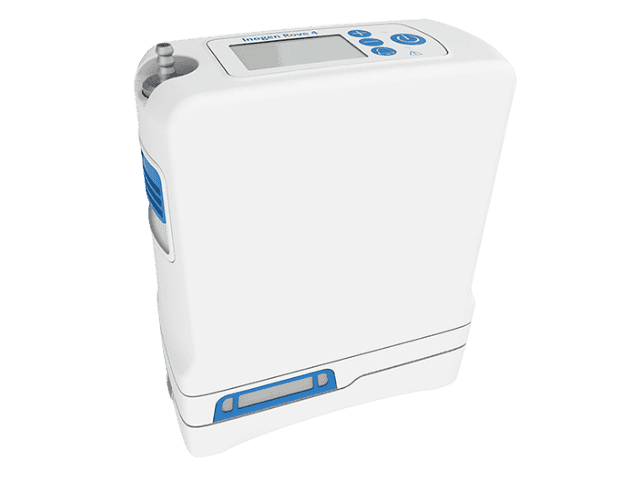
Inogen Rove 4: The Ultra-Portable Option
Base price: $2,695. This includes the unit with one battery, AC and DC power supplies, and a carry bag. Like all Inogen products, shipping is included. Financing is also available for most models.
If you’re an active senior who loves to participate in all types of activities, you’ll appreciate the Rove 4. This portable oxygen concentrator is Inogen’s smallest and lightest option. It weighs 2.9 pounds with a standard battery.6 It’s about the size of a small handbag and easy to carry over a shoulder or toss in a bag. It offers four pulse-dose flow settings (1-4) and delivers up to 840 mL per minute of medical-grade oxygen using Inogen’s Intelligent Delivery Technology, which senses when the user inhales and delivers oxygen at precisely the right moment.
Battery life depends on the configuration: the standard battery runs about 3 hours, the intermediate battery lasts around 4 hours and 15 minutes, and the extended battery provides roughly 5 hours and 45 minutes — all at flow setting 1. The Rove 4 is FAA-approved for air travel, runs at just 39 dBA (about as loud as a quiet library), and has an expected service life of up to eight years. It comes with a three-year warranty on the concentrator and a one-year warranty on accessories. If you’re planning on taking a vacation, you can take this unit with you on a plane, bus, or train. Just make a note to yourself that Medicare won’t cover the cost of oxygen needed for air travel.7
Inogen Rove 6: The Premium Portable
Base price: $2,795
The Rove 6 is Inogen’s flagship portable unit and the one most experts consider the gold standard for travel in 2026.8 It offers six pulse-dose flow settings (1–6) and delivers up to 1,260 mL of oxygen per minute. At 4.8 pounds with the standard battery, it’s a bit heavier than the Rove 4 but still remarkably light for what it does.
Where the Rove 6 really shines is battery life. The standard battery lasts up to 6 hours and 15 minutes at setting 1, and the extended battery pushes that to an impressive 12 hours and 45 minutes. That’s a full day of freedom without needing a wall outlet. Like the Rove 4, it’s approved by the Federal Aviation Administration (FAA), whisper-quiet at 39 dBA, and built for an eight-year service life. It also includes the Inogen Connect app for Bluetooth monitoring of battery levels and system status.
For those who need higher flow settings or longer battery life, the extra $300 over the Rove 4 is well worth considering.
Inogen At Home: The Stationary Workhorse
Base price: $1,695
For people who primarily need oxygen while at home for things like sleeping, reading, and watching TV, the Inogen At Home is a solid choice. This unit is perfect for seniors who are aging in place, as well as for those who live in retirement communities or assisted living facilities.
Did You Know? If you move into assisted living from your current home, Medicare Part B will continue to pay for your oxygen unit and equipment.
It provides continuous-flow oxygen (not pulse dose) at up to 5 liters per minute across five settings. Unlike the portable units, it plugs into a standard wall outlet and runs indefinitely. At about 18 pounds, it’s one of the lightest stationary concentrators available, and roughly half the weight of many competitors. It’s also energy-efficient, using just 100 watts at setting 2, which can translate to meaningful savings on the electric bill over time. It operates at 45 dBA at setting 2 and comes with a three-year warranty.
Inogen Voxi 5: The Budget-Friendly Home Option
Starting price: $795
New to the lineup, the Voxi 5 is Inogen’s value-oriented stationary concentrator, developed in collaboration with Yuwell Medical. It delivers up to 5 liters per minute of continuous-flow oxygen with an oxygen concentration of 87 to 96 percent. At about 34 pounds on caster wheels, it’s heavier than the At Home but still easy to roll between rooms. It runs at 45 dBA and comes with audible safety alarms and a clear display. The Voxi 5 has a designed service life of up to three years and is offered with a three-year or five-year warranty.
Thanks to its affordable price, this is a terrific option for a second unit in another room or for anyone where budget is a primary concern.
Pricing at a Glance
Here’s a side-by-side comparison of the individual concentrator prices. All prices are manufacturer’s suggested retail prices (MSRPs) and may vary through authorized dealers or during promotions.
| Feature | Rove 4 | Rove 6 | At Home | Voxi 5 |
|---|---|---|---|---|
| Base Price | ~$2,995 | ~$3,295 | ~$1,703 | ~$795 |
| Type | Portable | Portable | Stationary | Stationary |
| Weight | 2.9 lbs | 4.8 lbs | 18 lbs | 34 lbs |
| Flow Settings | 1-4 Pulse | 1-6 Pulse | 1-5 Cont. | 1-5 Cont. |
| Max Battery Life | 5 hr 45 min | 12 hr 45 min | AC Only | AC Only |
| FAA Approved | Yes | Yes | N/A | N/A |
| Service Life | Up to 8 yrs | Up to 8 yrs | Not listed | Up to 3 yrs |
Note: Max battery life figures are at flow setting 1 with the largest available battery. Actual runtime varies with settings, breathing rate, and conditions.
Freedom Bundles
For those who need oxygen both at home and on the go, the Freedom Bundles pair an Inogen At Home unit with one of the portable concentrators at a combined price. Depending on the model and warranty tier, bundles range from about $4,247 to $5,352. Choosing a bundle with a lifetime warranty on the portable unit costs more upfront but can provide significant peace of mind and long-term value.
Insurance, Medicare, and Payment Options
Medicare covers the rental of oxygen equipment and accessories for eligible patients. To be eligible, you must meet all of these requirements:9
- Your health care provider says you aren’t getting enough oxygen
- Your health might improve with oxygen therapy
- Your arterial blood gas level falls within a certain range
Medicare will cover their portion of the cost of your unit for 36 months to five years. If you think you will need your unit for a longer period of time, you may wish to purchase a unit outright. Oxygen concentrators can be bought new, used, or refurbished. Make sure to only work with a reputable provider.
Did You Know? Not everyone who is prescribed oxygen will need it permanently. Oxygen units are often needed temporarily, for conditions like pneumonia or COPD exacerbation.
Private health insurance plans also cover the cost of oxygen units and accessories, provided that you have a health care provider’s prescription.
Whether you have Medicare or private insurance, you may incur some portion of the cost of your unit. If you have Medicaid, you may have no out-of-pocket costs, but this varies from state to state.
Beyond insurance, Inogen offers several ways to make the cost more manageable: HSA or FSA funds can be applied, flexible financing plans are available, and cash-pay customers can ask about discounts. Many authorized dealers also run promotions, so it’s worth shopping around, just make sure the purchase is through an authorized reseller to protect the warranty.
What Stands Out About Inogen
There’s a lot to appreciate. The Rove series concentrators are portable in a way that older oxygen equipment simply isn’t, with devices lighter than a bag of sugar that can run all day on a single charge. The FAA approval on both portable models means travel doesn’t have to stop, and the quiet operation means they can be used in restaurants, at church, or during family gatherings without drawing attention. The eight-year expected service life on the Rove models is among the best in the industry, and the Inogen Connect app adds a modern convenience layer that makes daily management easier.
It’s worth noting that Inogen now has options at multiple price points. The Voxi 5 at around $795 makes home oxygen therapy accessible to folks who might have been priced out before, and the Freedom Bundles offer a practical all-in-one solution for people who need both portable and stationary coverage.
What to Watch Out for When Shopping for an Oxygen Concentrator
No product is perfect, and it’s important to be upfront about the limitations. The portable models deliver pulse-dose oxygen only; they sense a breath and deliver a burst of oxygen on inhalation. Some medical conditions require continuous-flow oxygen, which only the stationary units provide. It’s essential to talk with a doctor about which delivery type is appropriate before buying. Additionally, Inogen’s portable devices are not intended for use by tracheotomized patients or for pediatric use.
Cost is another consideration. At roughly $3,000 or more for a portable unit, this is a significant investment. And while authorized dealers sometimes offer promotional pricing, be cautious about deeply discounted units from unauthorized sellers. The warranty coverage may be voided or the device may not have been properly maintained.
One more word of caution: inexpensive “oxygen concentrators” sold on Amazon for a few hundred dollars are generally non-medical devices that do not maintain proper oxygen purity at medical flow rates. If supplemental oxygen has been prescribed, these budget devices may not be safe. Always buy FDA-cleared equipment from an authorized dealer.
The Bottom Line
Inogen makes some of the best portable oxygen concentrators on the market, and for good reason. Their devices are light, quiet, long-lasting, and backed by a company with over two decades of experience in respiratory care. For anyone who has been prescribed supplemental oxygen, Inogen deserves a spot near the top of the list, particularly if independence, travel, and an active lifestyle are priorities.
The best first step is to talk with a doctor about whether pulse-dose or continuous-flow oxygen is the right fit. From there, calling Inogen directly or visiting their website to check insurance eligibility and current pricing makes the process a lot easier. And wherever the purchase happens, make sure it’s from an authorized dealer to preserve the full manufacturer warranty.
-
Better Business Bureau. (n.d.). Inogen One.
-
Inogen. (n.d.). Awards.
-
Inogen. (n.d.). Find the oxygen concentrator that fits your lifestyle.
-
National Library of Medicine. (2024). The National Prevalence of Supplemental Oxygen Use in Persons with Chronic Obstructive Pulmonary Disease: A Comparison of Claims-based and Self-reported Supplemental Oxygen Use.
-
U.S. Department of Health and Human Services. (2024). Medicare Payments to Suppliers for Oxygen and Oxygen Equipment.
-
Inogen. (n.d.). Inogen Rove 4™ Portable Oxygen Concentrator.
-
Medicare.gov. (n.d.). Oxygen equipment & accessories.
-
Main Clinic Supply. (2025). The 2026 Portable Oxygen Concentrator Guide: Reviews, Ratings & New Tech.
-
Medicare.gov. (n.d.). Oxygen equipment & accessories.