A Guide to Portable Oxygen
From choosing between pulse and continuous flow to understanding costs, Medicare coverage, and travel tips, here’s what you need to know about portable oxygen.


SeniorLiving.org is supported by commissions from providers listed on our site. Read our Editorial Guidelines
If you or someone you love has recently been told they need supplemental oxygen, you may be worried about how this will affect your ability to enjoy life. Fears about losing independence are common in anticipation of this treatment. However, given the portable oxygen options available today, instead of losing your independence you may actually be getting it back.
In this guide, we’ll walk you through everything you need to know about portable oxygen, including Medicare coverage, travel tips, costs, and how to choose the option that’s best for you.

Table of Contents
What Is a Portable Oxygen Concentrator?
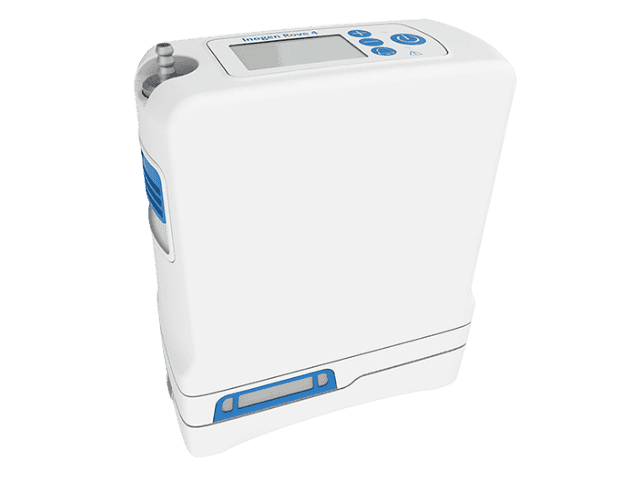
A portable oxygen concentrator, often called a POC, is a compact, battery-powered medical device. POCs work by pulling in air and concentrating the air’s oxygen content, so you can breathe it in easily through a nasal cannula or mask. The air we breathe is roughly 21 percent oxygen and 78 percent nitrogen. A POC filters out the nitrogen and delivers oxygen at around 90 to 95 percent purity, giving your lungs the boost they need.1
If you’ve been struggling to breathe, the relief you feel will be almost immediate. POCs reach stable oxygen levels in under five minutes. Along with better breathing, you should eventually have less fatigue. If you’ve been experiencing confusion or trouble concentrating due to low oxygen intake, you may also acquire sharper clarity of thought.
Did You Know? More than 1.5 million adults in the United States currently use supplemental oxygen for a variety of respiratory conditions, according to an official workshop report from the American Thoracic Society.2 If you are one of them, or are about to be, you are far from alone.
Unlike traditional oxygen tanks, POCs are refillable, so you never run out of oxygen. Most POCs run on lithium-ion, rechargeable batteries. Your unit will continually draw oxygen out of the surrounding air, until the battery is depleted. Most POC units have space for a spare, fully charged backup battery you can swap out for the depleted one when you’re on-the-go. That means less time worrying about running low on oxygen, and more time living your life.
Most POCs weigh between three and ten pounds, though some larger continuous-flow models can be heavier. They come with carrying cases, shoulder bags, or small wheeled carts, making it easy to bring one to the grocery store, a grandchild’s soccer game, or that once-in-a-lifetime trip you thought you’d have to forgo across the country (or the world).
Pulse Flow vs. Continuous Flow: Which One Do You Need?
This is one of the first and most important distinctions you will encounter, and it is entirely determined by a doctor’s prescription, not personal preference.
Pulse Flow
Pulse-flow concentrators deliver a burst of oxygen each time they detect an inhalation. Because they are not running constantly, they tend to be smaller, lighter, and have longer battery life.
For moderate oxygen needs of around one to two liters per minute a pulse-flow unit may be the right fit. These are popular with active users who want something lightweight for errands, walks, and travel. They are also helpful during physical therapy, and light workouts.
Continuous Flow
Continuous-flow concentrators deliver a steady, uninterrupted stream of oxygen regardless of breathing pattern. For more severe COPD, sleep apnea, or higher oxygen requirements, generally around three to five liters per minute, a doctor may prescribe continuous flow. These units tend to be heavier and use more battery, but they provide reliable delivery around the clock, including during sleep.
The bottom line: never choose a flow type without medical guidance. A physician will conduct blood gas or pulse oximetry testing to determine exactly what your body needs. A device that is wrong for your prescription can be ineffective or even dangerous. Always follow your doctor’s recommendation on this.
Did You Know? If you wear glasses, hearing aids, or both, you can still comfortably use a POC. Some users say they’re most comfortable if they put their hearing aids on first, followed by their glasses, and finally, the POCs oxygen cannula.3
How Much Does a Portable Oxygen Concentrator Cost?
New, medical-grade portable oxygen concentrators from established brands typically cost between about $2,000 and $3,500, with pricing influenced by oxygen delivery type, portability, battery life, and brand reputation. Certified refurbished units from authorized dealers generally run between $1,000 and $2,500 and usually come with some level of warranty coverage.4
One word of caution: you may see concentrators sold online for just a few hundred dollars, often under unfamiliar brand names. Many of these are non-medical devices that have not been cleared by the FDA for medical use. Independent testing has found that some budget units fail to maintain medical-grade oxygen purity at higher flow rates. If a doctor has prescribed oxygen therapy, stick with FDA-cleared devices from reputable manufacturers or authorized dealers. Health is not the place to bargain hunt.
Did You Know? Both the Pulmonary Fibrosis Foundation and the American Lung Association caution patients against using non-prescription portable oxygen concentrators. Both organizations stress that only prescribed, FDA-approved units be used.5
Some well-known and trusted brands to consider include Inogen, CAIRE, Philips Respironics, ResMed, and Invacare. Each offers several models at different price points. Your doctor can match you with the right one.
Read out 2026 Inogen review to learn more about this popular brand.
Will Medicare Help Pay for Portable Oxygen?
Medicare Part B covers oxygen therapy equipment, including portable oxygen concentrators, as durable medical equipment (DME). However, Medicare covers rentals only, not purchases.6 Here is how it generally works:
- First, a doctor must certify that oxygen therapy is medically necessary. This involves specific blood gas or pulse oximetry testing that meets Medicare’s clinical criteria. To qualify, a patient’s arterial blood oxygen level must fall within a specified range, and the prescribing physician must document that alternative treatments have been tried.7
- Once approved, you can rent the equipment from a Medicare-enrolled supplier for up to a 36-month period. During that time, Medicare typically covers 80 percent of the approved rental cost after you meet the annual Part B deductible, which is $283 in 2026. You pay the remaining 20 percent as coinsurance.8
- After the 36-month rental period ends, the supplier is required to continue providing and maintaining the equipment for up to five years total, as long as there is a documented medical need. The rental payments stop after 36 months, but Medicare continues to cover supply costs like oxygen delivery for tanks.
Medicare reimburses suppliers the same amount, regardless of what equipment they provide. For that reason, some suppliers may offer a basic stationary home concentrator and portable tanks rather than a lightweight portable concentrator. For those who want the freedom and convenience of a modern POC, especially for travel, this may or may not be a good alternative. The best course of action is to talk to your doctor about your options. Then, you can make an educated decision about the type of unit that is best for you.
If you’re enrolled in a Medicare Advantage (Part C), your plan must cover at least what Original Medicare covers, but costs, supplier networks, and prior authorization requirements can vary. Ask your provider what your out of pocket costs and equipment options are, as these vary by plan.
Traveling with Your Portable Oxygen Concentrator
One of the most common fears among people starting oxygen therapy is that their traveling days are over. Luckily, you don’t need to let COPD, or other respiratory conditions, slow you down. Seniors today are more active than ever. You can travel wherever you choose, even if you need supplemental oxygen.
Rules and Regulations for Flying
The Federal Aviation Commission (FAA) requires all U.S. airlines operating aircraft with more than 19 seats to allow passengers to use FAA-approved portable oxygen concentrators on board during all phases of flight. Foreign airlines must also permit them on flights to and from U.S. soil.9
To fly with a POC, the device must be FDA-cleared and meet FAA acceptance criteria. Most modern concentrators from major brands carry a red label confirming FAA compliance. A signed physician statement is also required, detailing oxygen needs and flow rate. It’s a good idea to keep it available every time you fly.
Airlines typically require enough battery power for 150 percent of the total expected travel time, including layovers and potential delays. So if a trip is six hours door-to-door, plan for nine hours of battery life. Extra batteries must be carried in carry-on luggage and protected from damage.
Tips for Traveling
A few practical tips for flying: notify the airline ahead of time, stow the device under the seat in front of you during taxi, takeoff, and landing, and do not sit in an exit row while operating it. Traditional compressed oxygen tanks are not allowed on commercial flights, only concentrators.
For road trips, a POC can typically run off a car’s DC power outlet with the right adapter.
If you love hitting the high seas, many cruise lines allow concentrators on board with advance approval, usually requiring paperwork submitted 30 to 60 days before sailing.
Pro Tip: Travel insurance can save you thousands of dollars, if your trip is cancelled or delayed. Here are our top picks for the best travel insurance for seniors.
Caring for Your Device and Staying Safe
A portable oxygen concentrator is a reliable piece of medical equipment, but it does need a little TLC to keep running well:
- Keep the air intake filter clean. Most manufacturers recommend checking it weekly and replacing it on the schedule outlined in the user manual. A clogged filter makes the device work harder and can reduce oxygen purity.
- Do not leave a POC in a hot car. Extreme heat can damage the battery and internal components. Similarly, keep it dry — do not expose it to rain, and never rinse the exterior. A damp cloth is all that is needed for cleaning.
- Make sure the vents are never blocked while the device is running. Keep at least about ten inches of open space around the concentrator, and always use a carrying case designed for the specific model with proper ventilation cutouts.
- When using a POC in a car, crack a window or turn on the air conditioning. The device draws in ambient air, so adequate ventilation is important in enclosed spaces.
- And perhaps the most important safety note of all: oxygen supports combustion. Never smoke or allow open flames near a concentrator. Keep it away from candles, gas stoves, and fireplaces while it is running.
Final Thoughts
Starting oxygen therapy can feel like a turning point toward feeling better, not worse. The right portable oxygen concentrator can restore the energy and confidence to do the things that matter most, whether that is walking through the park, visiting family, or boarding a plane to somewhere new.
Talk to your doctor. Ask questions. Reach out to authorized dealers who can walk you through options without pressure. And remember: more than a million and a half Americans use supplemental oxygen every day and live full, active, wonderful lives. You can too.
-
American Lung Association. (2026). Oxygen Therapy: Getting Started with a Portable Oxygen Concentrator.
-
Annals of the American Thoracic Society. (2018). Optimizing Home Oxygen Therapy. An Official American Thoracic Society Workshop Report.
-
Inspire. (2018). Using Hearing Aids While on Oxygen.
-
Main Clinic Supply. (2025). Portable Oxygen Concentrator Price: 2025 New & Used Ranges Explained.
-
American Lung Association. (2026). Oxygen Therapy: Getting Started with a Portable Oxygen Concentrator.
Pulmonary Fibrosis Foundation. (2023). Pulmonary Fibrosis Foundation Position Statement on Non-prescription Supplemental Oxygen.
-
Centers for Medicare & Medicaid Services. (n.d.). Oxygen equipment & accessories.
-
Centers for Medicare & Medicaid Services. (2026). Oxygen & Oxygen Equipment.
-
Centers for Medicare & Medicaid Services. (n.d.). Oxygen equipment & accessories.
-
Federal Aviation Administration. (2021). Acceptance Criteria for Portable Oxygen Concentrators.