What Seniors Should Know About Portable Oxygen Concentrators for Travel
Traveling with a portable oxygen concentrator gives you freedom, but requires planning. Here’s what you need to know about airplane travel, cruises, and hitting the road with your POC


SeniorLiving.org is supported by commissions from providers listed on our site. Read our Editorial Guidelines
If you rely on supplemental oxygen, you might wonder whether senior travel is on the table. For most seniors, the short answer is yes!
Roughly one in five older adults with COPD use supplemental oxygen therapy, and a growing number are traveling domestically and internationally every single year, by plane, cruise ship, bus, train, and car.1
There’s no need to curtail your enjoyment of senior activities during travel. To travel comfortably and safely, make sure you have an FAA-approved device and that your battery has 150% capacity of the anticipated journey duration.
This guide covers everything you need, from FAA regulations to packing tips, so you can plan your next trip with confidence.

Did You Know? Not all Medigap plans include travel insurance. Even if your plan provides some level of coverage, it may not be enough to accommodate your medical needs in an emergency. Research your plan, and buy additional travel insurance if it makes sense for you.
Table of Contents
What Makes a Portable Oxygen Concentrator (POC) Travel-Friendly?
Not all portable oxygen concentrators are created equal when it comes to travel. A device that works beautifully at home might not be the best fit for a week-long cruise or multi-leg flight.
Here's what to look for:
- Weight and size: The best travel POCs weigh between 2.8 and 5 pounds, so that they’re light enough to carry over your shoulder without strain. Compact units can slide under an airline seat.
- Battery life: For road travel, look for a device that offers at least 4–5 hours of battery life at your prescribed flow setting. You should also carry a second battery and a DC car adapter. (We’ll go into regulations for flying with batteries below.)
- Delivery mode: POCs deliver oxygen in one of two ways: pulse dose (oxygen delivered in bursts timed to your breath) or continuous flow (a steady stream regardless of breathing rate). Pulse dose units are generally lighter and more battery-efficient, making them the more popular choice for travel, but your physician's prescription determines which is clinically appropriate for you.
- Noise level: You'll be using this device in quiet spaces, such as airplane cabins, hotel rooms, and theaters. Most modern travel POCs operate at 40–48 decibels, roughly equivalent to a quiet conversation. To make sure your unit will be unobtrusive to others, double-check the manufacturer's spec sheet.
Pro Tip: Before purchasing or renting a travel POC, ask your DME (durable medical equipment) supplier if they offer a trial period. Testing the device during a short excursion is the most reliable way to confirm it will suit your needs for a longer trip.
Flying With a Portable Oxygen Concentrator
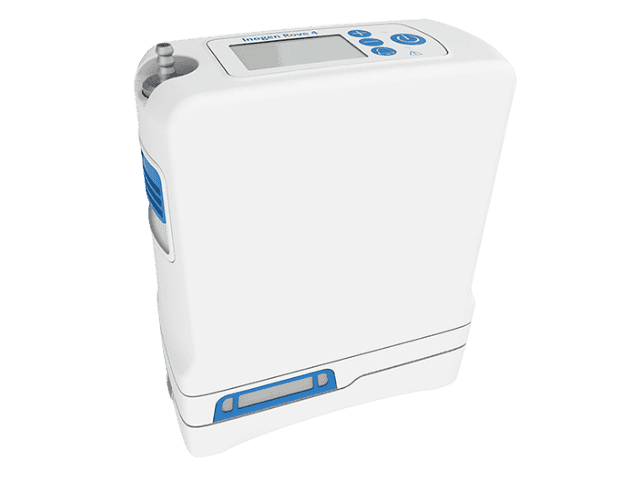
Inogen's Rove 4 portable oxygen concentrator is FAA-approved.
Air travel can be a concern for many seniors who require portable oxygen. Whether you’re a seasoned or occasional flyer, confusion about Federal Aviation Administration (FAA) rules, worries about safety in the air, and preparing for possible delays can all cause anxiety. The more you know about the FAA’s rules, the more relaxed (and prepared) you will be.
First off, FAA rulings state that all passengers who require oxygen must be allowed to bring FAA-approved portable oxygen concentrators on U.S. aircraft containing more than 19 seats. They also state that foreign airlines must allow POCs on all flights to and from U.S. soil.2 In practical terms, this means your right to fly with a POC is federally protected, provided that your device meets FAA criteria.
The FAA has established acceptance criteria for the types of POCs that can be used on aircraft:3 They have also determined rules for POC transport. Here’s a breakdown of what you need to know:
- Your POC must be legally marketed in the U.S., in accordance with FDA requirements
- Your POC must not radiate radio frequency emissions that interfere with aircraft systems
- Your POC cannot generate compressed gas
- Your POC can’t contain hazardous material, except for FAA-approved batteries
- Your POC must satisfy the acceptance criteria for required POC labeling. It must also have a label with this statement clearly marked in red: “The manufacturer of this POC has determined this device conforms to all applicable FAA acceptance criteria for POC carriage and use on board aircraft.”
- FAA requirements state that you must carry enough battery power to supply your POC for 150 percent or more of the maximum expected flight duration. This takes delays, taxying time, and other issues into account.4 Given current travel mores, it may make sense to exceed this minimum requirement.
- No single POC battery is to exceed 160 Watt-hours (Wh). If your battery is between 101-160 Wh, it will require prior approval from each airline you’re flying with.5
- Spare batteries cannot be checked. They must also meet the approved limit for Wh. Spare batteries must be placed in your carry-on luggage. They must also have their terminals protected against short circuits.
- POCs are categorized as assistive devices. For that reason, they’re not counted as carry-on luggage. You can bring the equivalent of the airline’s carry-on bag limit onto the plane with you, but do keep your comfort in mind, when deciding how many items you’re comfortable juggling.
- For full descriptors of each requirement that include rules and regulations identifiers, visit the Federal Aviation Administration website.
Step-by-Step Tips for Flying with a POC
- Notify your airline: Most carriers require 48–72 hours' advance notice if you plan to use a POC in-flight. Contact the airline's accessibility or special services team directly to find out if additional requirements apply. You can also let them know at that time if you need additional accommodations, both in the airport and on your flight. Make sure to notify each airline you’ll be flying with.
- Get a physician's travel letter: Many airlines require written confirmation from your doctor stating your diagnosis, oxygen needs, and fitness to fly. Ask your provider for this at least a week before departure. Make several copies and keep them in separate places, such as one in your carry-on and one in your checked luggage. Our expert Karen Selby also recommends taking a picture of your travel letter for easy access and peace of mind.
- Additional documentation to put in your carry-on: In addition to your physician’s letter and extra battery, keep your POC prescription and device documentation in your carry-on.
- Inform TSA: Let the TSA agent know you have a medical device when you approach the security checkpoint. The POC will be screened but should not be confiscated or separated from you.
Pro Tip: Arrive at the airport earlier than usual on your first trip flying with a POC. This extra time buffer reduces stress if any questions come up at the gate.
Road Trips, Cruises, Bus and Train Travel, and International Travel
Car Trips
Road travel is actually the easiest scenario for POC users. Most concentrators include a DC power adapter that plugs directly into your car's 12-volt outlet, so you can run the device continuously while driving without touching your battery reserves.
If you’re traveling to and from your destination in a hired car, inform them ahead of time that you will need access to an outlet, unless it’s a short trip to the airport, bus depot, or train station.
Call lodging ahead to confirm electrical outlet accessibility in your room.
Don’t smoke in a car where oxygen is being kept. You should also avoid keeping your unit in the car if it is overheated. Keep the windows open, or the air conditioner on. It also makes sense to secure the unit with a seat belt on the seat next to you.
Bus and Train Travel
Call the bus or train company three days or more before you travel. Ask them for a breakdown of their POC policies. As with train travel, you should carry your batteries with you, rather than checking them. You should also carry documentation, including a physician’s letter.6
Cruise Travel
Major cruise lines accommodate POC users, but policies vary by carrier. Contact the cruise line's special needs or accessibility department, not customer service, to confirm cabin outlet availability, required documentation, and whether the ship's medical staff needs to be notified in advance. Some lines may request a physician's letter. It’s a good idea to have one with you, just in case.
Did You Know? Your AARP membership can get you great discounts on cruise travel! Find out what’s available before you book.
International Travel
Traveling abroad adds an additional layer of planning. Different countries use different electrical standards, so bring the appropriate voltage adapters for your destination. Carry translated documentation of your medical needs, and consider purchasing travel medical insurance that covers oxygen-related emergencies before you depart.
How to Prepare Before You Leave Home
Here are a few practical steps that can make your travel experience dramatically smoother:
- Contact your DME supplier at least two weeks before departure to ensure your device is travel-ready and fully serviced.
- Create a travel kit that includes your POC, two fully charged batteries, AC and DC power adapters, your prescription, physician's letter, device manual, and a list of local medical facilities at your destination.
- Research oxygen suppliers at your destination, in case of device malfunction or an extended stay.
- Check your insurance to understand what is and isn't covered if you need emergency oxygen equipment while away from home.
Pro Tip: Research the altitude of your destination before you go. Higher elevations in places like New Mexico, mean less ambient oxygen, which can affect your therapy needs. Talk to your doctor about whether your prescribed settings need to be adjusted for your trip. In some locales, like Machu Picchu in Peru, some hotels provide pumped oxygen in certain rooms to help guests manage altitude sickness.
Conclusion
Traveling with supplemental oxygen isn't the obstacle it once was. Rather, it's a manageable and common reality for millions of older adults every year. If you’ve gotten used to staying close to home, you may be nervous about setting forth. But as long as you have an FAA-compliant POC, a solid understanding of the rules, and a bit of advanced planning, there’s virtually no destination that’s off the table. The world is still yours to explore. Pack smart, communicate early, and go enjoy it.
FAQs
-
Can I bring a portable oxygen concentrator on an airplane?
Yes, FAA-approved POCs are permitted on all U.S. commercial flights with more than 19 seats, and your right to fly with one is federally protected. You must notify your airline in advance and carry at least 150% of your expected flight time in battery capacity.
-
Does Medicare cover a portable oxygen concentrator for travel?
Medicare Part B may cover portable oxygen equipment if you meet medical necessity criteria, but coverage terms vary by plan and situation. Contact your Medicare plan or DME supplier to confirm what’s covered before you travel.
-
How do I know if my POC is FAA-approved?
Look for a permanent red-text label on the exterior of your device confirming FAA compliance. You can also verify with your DME supplier or check the manufacturer’s documentation.
-
What happens if my POC battery dies mid-flight?
To avoid this, be sure to adhere to FAA’s 150% battery rule of thumb beforehand — carrying extra battery capacity is your best protection. Otherwise, inform the flight crew if you’re having device issues; they are trained to assist passengers with medical equipment needs.
-
Can I use a POC on a cruise ship?
Yes, most major cruise lines accommodate POC users. Contact the cruise line’s accessibility department before booking to confirm cabin outlet availability and any required documentation.
-
National Library of Medicine. (2024). The National Prevalence of Supplemental Oxygen Use in Persons with Chronic Obstructive Pulmonary Disease: A Comparison of Claims-based and Self-reported Supplemental Oxygen Use.
-
Oxygen Concentrator Store. (2026). FAA Regulations for Portable Oxygen Concentrators on Airplanes.
-
Federal Aviation Administration. (2021). Acceptance Criteria for Portable Oxygen Concentrators.
-
American Lung Association. (2025). Respiratory Groups Letter to FAA re Concerns with Oxygen User Accessibility.
-
Federal Aviation Administration. (2026). PackSafe – Lithium Batteries.
-
American Lung Association. (n.d.). Traveling with Oxygen.