UnitedHealthcare Medicare Supplement Plans
UnitedHealthcare is an AARP-endorsed Medigap carrier with several plan options.

How We Evaluated UnitedHealthcare
Our dedicated team of researchers analyzed UnitedHealthcare’s Medigap plans. We focused on key elements like cost-effectiveness, customer service quality, coverage options, carrier dependability, and any additional perks. Here are some other factors that guided our review:
- Prices and expenses: We examined the monthly costs associated with each plan, calculating monthly premiums like co-payments and deductibles. We also evaluated the methods used to calculate premiums.
- Renewal assurance: We verified whether or not plans received a guaranteed renewal as long as premiums were consistently paid.
- State coverage and plan options: We examined the number of states where plans are offered, the variety, and how they stack up against competitors. We also looked at any state regulations or rules that might affect coverage.
- Provider reputation and support: We assessed UnitedHealthcare’s standing as an insurer, as well as ratings, customer feedback, and complaints. In addition, we looked at availability of customer support and ways customers can reach an agent.

UnitedHealthcare offers the only Medicare supplement plans endorsed by AARP, and their plans cover more than 4.5 million older adults nationwide.1 For this review, we spent 50 hours researching and evaluating UnitedHealthcare’s Medigap plans. We also compared them to our picks for the best Medigap plans and spoke with customer service to understand who they’re best for and what they offer. Our team evaluated them using important criteria like plan variety, prices, nationwide availability, customer service, and more.
Below, we’ll take a deep dive into the company’s Medigap offerings to help you determine if they provide the coverage you’re looking for.

UnitedHealthcare at a Glance
Pros About UnitedHealthcare
- Eight Medigap plans offered
- Low premium options
- Endorsed by AARP
- More than 30 years serving seniors
- Easy online application process
- Nationwide availability
- Wellness extras
Cons About UnitedHealthcare
- Offerings vary state-to-state
- No Plan D or Plan M options
- AARP membership required, though beneficiaries aren’t required to renew their membership after the first year, according to Medicare Expert Danielle Kunkle Roberts.
Do I Need a Medigap Plan?
Before we get into the nitty-gritty of UnitedHealthcare plans, you may wonder why older adults need a Medigap plan in the first place. Well, as mentioned above, Original Medicare doesn’t cover everything. In fact, it only covers about 80 percent of the medical costs it approves. The remaining 20 percent is your responsibility. With no out-of-pocket maximum, predicting yearly medical expenses can be nearly impossible. Medicare supplement insurance helps protect more than 14.5 million people eligible for Medicare from high out-of-pocket costs not covered by Medicare.2
Let’s say you have a major surgery that costs tens of thousands of dollars. Paying 20 percent of that surgery can be quite a blow. That’s why about 89 percent of older adults supplement their Original Medicare with employer-sponsored coverage, Medicaid, or a Medigap plan like one from UnitedHealthcare.3
Still not sure if Medigap is right for you? Watch our video below with Medicare expert Danielle Roberts to learn more.
UnitedHealthcare offers a variety of Medigap plans endorsed by the AARP to meet of variety of needs and budgets.

Overview of UnitedHealthcare Medigap Plans
The federal government has created 10 standardized Medigap plans for private insurance companies to sell and UnitedHealthcare offers eight of them. We appreciate that UnitedHealthcare has a good variety of plans, as other companies we’ve reviewed, like HealthSpring, offer a more limited selection.
Let’s take a look at the eight Medigap plans offered by UnitedHealthcare and the benefits of each.
| Benefits | A | B | C* | F* | G | K | L | N |
|---|---|---|---|---|---|---|---|---|
| Medicare Part A coinsurance and hospital coverage, and an extra 365 days of coverage after Medicare benefits are used up | Yes | Yes | Yes | Yes | Yes | Yes | Yes | Yes |
| Medicare Part B coinsurance or copayment | Yes | Yes | Yes | Yes | Yes | 50% | 75% | Yes |
| Part A hospice care coinsurance or copayment | Yes | Yes | Yes | Yes | Yes | 50% | 75% | Yes |
| Medicare Part A deductible | No | Yes | Yes | Yes | Yes | 50% | 75% | Yes |
| Skilled nursing facility care coinsurance | No | No | Yes | Yes | Yes | 50% | 75% | Yes |
| Medicare Part B deductible | No | No | Yes | Yes | No | No | No | No |
| Part B excess charge | No | No | No | Yes | Yes | No | No | No |
*Due to changes made by the federal government, plans C and F aren't available to seniors who were newly eligible for Medicare on or after January 1, 2020.
Which UnitedHealthcare Medigap Plan Is Right for Me?
Your lifestyle, health condition, and budget should be considered when selecting a Medigap plan from UnitedHealthcare. Each plan has its pros and cons, but we’ve gone ahead and highlighted a few we recommend for seniors based on those factors. Similar to Blue Cross Blue Shield, certain UnitedHealthcare Medigap plans come with discounts on dental, hearing, and vision, a free gym membership, and a 24/7 nurseline, though they aren’t available in all states.
Visit our UnitedHealthcare and senior care guide to learn more about the types of care this carrier’s plans will cover.
Seniors Who Want Basic Coverage
Recommended Plans: A or B
Designed to cover basic expenses not covered by Original Medicare, Medigap Plans A and B include hospital stays, home health care, and hospice care. Just be prepared to pay for Medicare Part B excess charges, emergency care when out of the country, and coinsurance while staying in a skilled nursing facility.
Seniors Who Rarely Visit the Doctor
Recommended Plans: F or G
Medigap plans F and G have high-deductible options. For older adults who are managing a chronic illness, this can be an ideal option. Frequent appointments and procedures allow you to meet your deductible and then begin receiving the benefits of the Medigap plan. Plan G is a popular Medicare supplement plan and helps cover Medicare Part A hospital expenses and services, the Part A deductible, and the Part B coinsurance.4
Seniors Seeking Broad Coverage Without Networks or Referrals
Recommended Plans: G and N
Danielle Kunkle Robertes notes that Medigap Plan G and Plan F are two of the most often recommended plans. Medigap Plans G and N are well suited for people who want predictable out-of-pocket costs and the freedom to see any doctor nationwide who accepts Medicare.
Plan G is often best for beneficiaries who prefer maximum coverage and minimal surprise expenses, while Plan N can be a good fit for those willing to pay small copays in exchange for lower monthly premiums. Both plans are especially popular with retirees who want long-term stability without provider networks or referrals.
How Much Do UnitedHealthcare Medigap Plans Cost?
Monthly premiums for Medigap plans are dependent on your geographic location, tobacco use, and gender. To give you a ballpark idea, we’ve provided the premium estimates for a 65-year-old nonsmoking male living in Orlando, Florida. In most states, UnitedHealthcare also offers a 5 percent household discount. To benefit from this discount, both spouses need to buy a Medigap policy.
| Plan | Monthly Price |
|---|---|
| A | $180.06 |
| B | $218.53 |
| C | Not available to seniors who were newly eligible for Medicare on or after January 1, 2020 |
| F | Not available to seniors who were newly eligible for Medicare on or after January 1, 2020 |
| G | $208.64 |
| K | $68.22 |
| L | $151.42 |
| N | $178.33 |
UnitedHealthcare Pricing Method
Health insurance companies price their Medigap policies using one of three methods: community-rated, issue-age-rated, and attained-age-rated.3 Keep in mind, not all states allow all three methods to be used. Here’s a quick definition of the three methods:
- Community-rated: Every senior in the community who has the Medigap policy is charged the same monthly premium regardless of age. This means your premiums may go up due to other factors like inflation, but not because of your age.
- Issue-age-rated: Your premium is based on the age you are when you purchase the Medigap policy – the younger you are, the cheaper your premium is. It is advantageous to buy a policy early from a company using this pricing method. Your premiums may still go up due to inflation.
- Attained-age-related: The premium is based on your current age at enrollment and increases as you get older. Premiums can also increase due to other factors, such as inflation.
Did You Know? States where companies can’t use age to determine pricing include Arkansas, Connecticut, Maine, Massachusetts, Minnesota, New York, Vermont, and Washington.5
UnitedHealthcare uses a community-rated pricing method in some states, which may appeal to older seniors, as your rates won’t increase with age. For comparison, competitors we’ve reviewed, like Humana, use an attained-age pricing method, which means the older you are, the more you’ll pay. UnitedHealthcare may offer better premiums to seniors in their 70s and beyond, and rates won't increase due to age.
How to Buy a UnitedHealthcare Medigap Policy
Enrolling in a UnitedHealthcare Medigap policy can be done with a few clicks from your computer. Or you can pick up the phone and call one of their friendly representatives to walk you through the process. They are available 8 a.m. to 8 p.m., seven days a week by phone. You also have the option to make an appointment to meet with a friendly agent in your area or use the live chat feature on the website.
We recommend purchasing a Medigap policy during your six-month Medigap open enrollment period. This will get you the best monthly premium prices and the most plans to select from. The six-month open enrollment period starts the month you enroll in Medicare Part B and are 65 or older.
Some people qualify for Medicare before the age of 65 due to disability. These people will get an initial six-month Open Enrollment Period starting with the Part B effective date. Later, when they turn 65, they will qualify for a second six-month window.
If you miss this six-month window, you may not be able to buy a policy, or it could be much more costly. So, mark your calendar! Missing this window could cost you big bucks in the long run.
If you’re interested in going the online route, here are the few steps you’ll need to take.
-
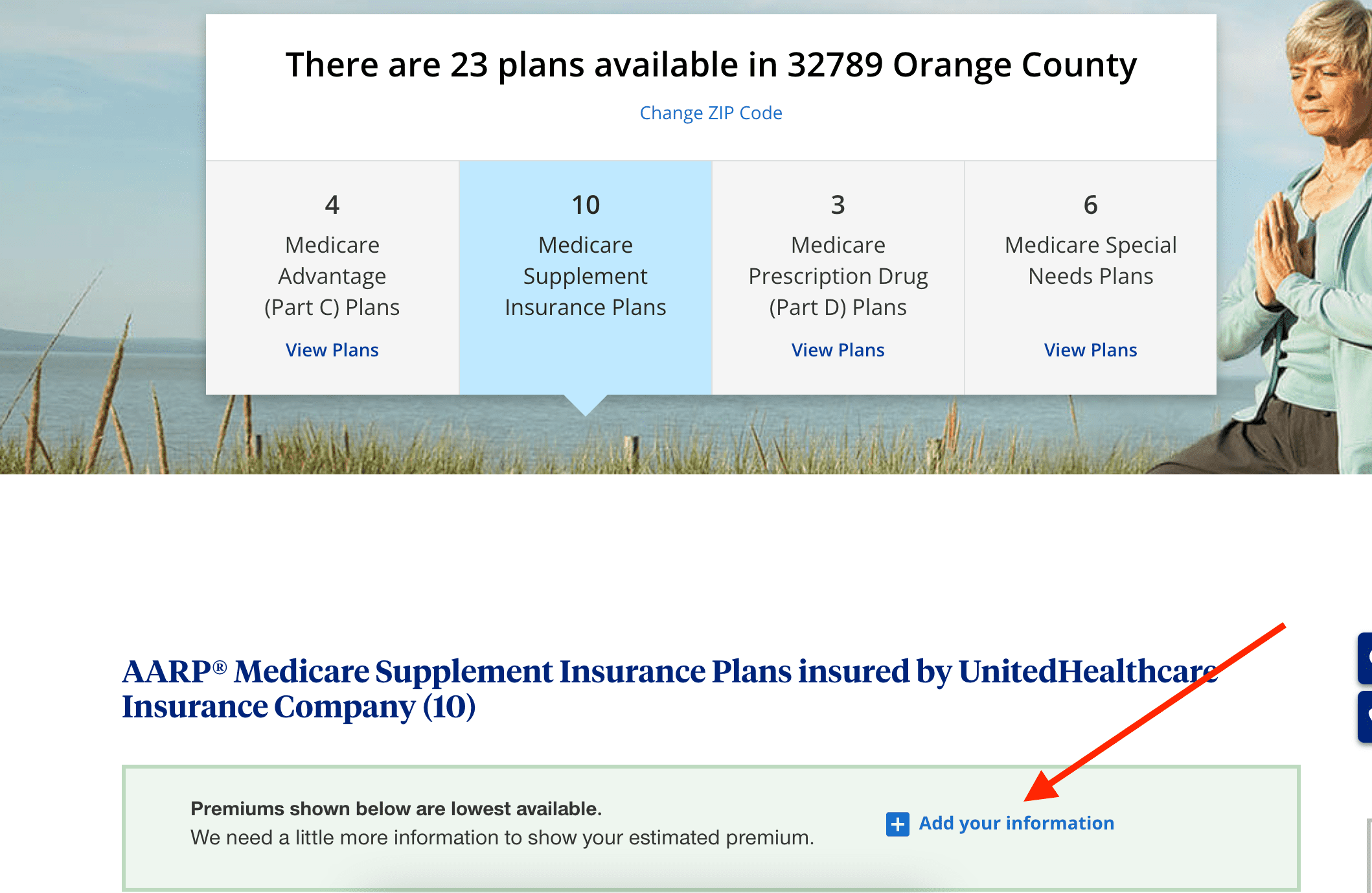
- Head to UnitedHealthcare's website and type in your ZIP code.

Enter your ZIP code on UnitedHealthcare's website
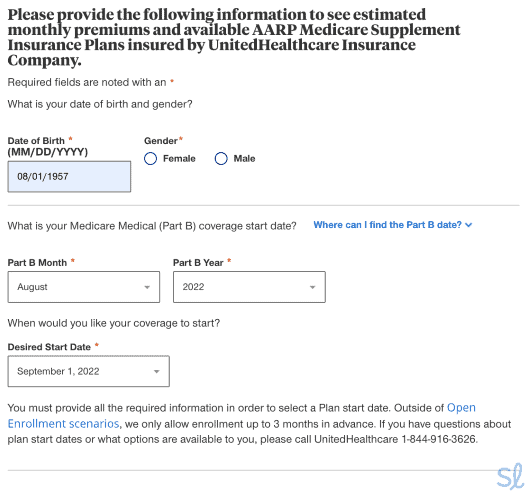
- Next, you’ll need to enter a few details, such as your date of birth and Medicare effective dates.

Click “Add your information” on the UnitedHealthcare search tool

Enter your information to view UnitedHealthcare's plan options
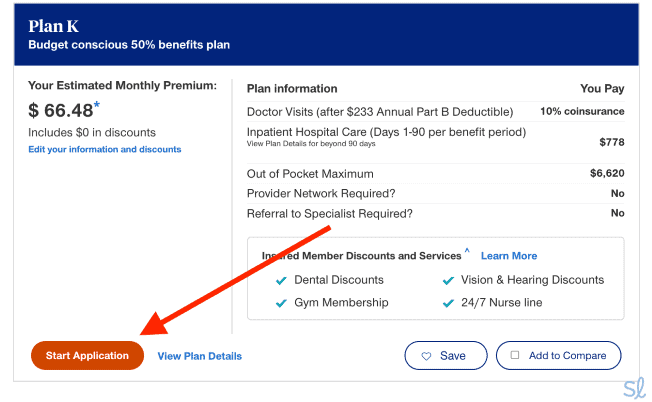
- After clicking “View Plans,” you’ll be able to see the plans available in your area and estimated monthly premiums. You can shop and compare plans to see which is the best choice for you. Once you have selected the plan you’d like to enroll in, click “Start Application.”

Click “Start Application” for your chosen UnitedHealthcare plan
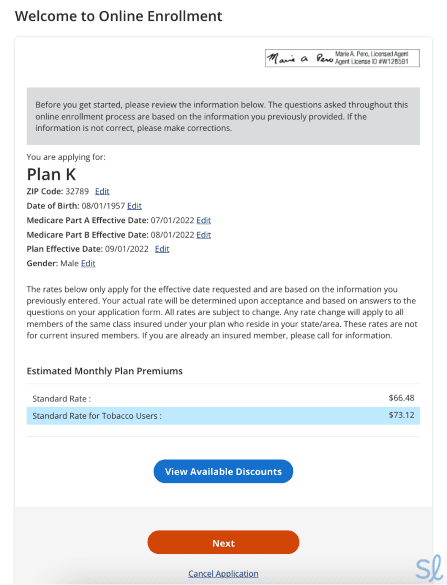
- Next, you’ll want to review your information and start the application process.

Review your chosen UnitedHealthcare plan
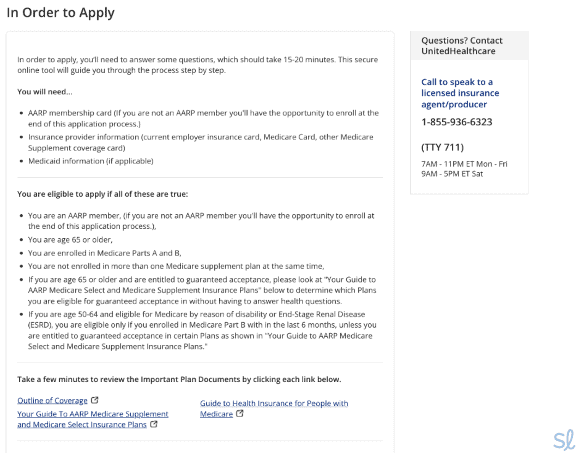
- In the application process, you’ll be asked to supply your Medicare information, the payment details, and confirm other important information. Remember, you can call an agent for assistance at any time. The phone number is listed to the right side on every screen.

Reviewing UnitedHealthcare application requirements
- Head to UnitedHealthcare's website and type in your ZIP code.

UnitedHealthcare vs. the Competition
We recommend comparing carriers before signing up for a Medigap plan. Here’s a closer look:
UnitedHealthcare vs. HealthSpring
UnitedHealthcare plans are available in every state, including Massachusetts. Cigna is not available in all states and only offers four plans. With Cigna, you can save up to 25 percent, including a premium discount of up to 20 percent plus an additional 5 percent if you apply online. Cigna offers a 7 percent household discount compared to only 5 percent from UnitedHealthcare. Head to our Cigna Medigap review for more information.
UnitedHealthcare vs. Mutual of Omaha
UnitedHealthcare is the only carrier that covers all states. Mutual of Omaha comes close in covering all states, with the exception of Massachusetts. Certain UnitedHealthcare Medigap plans in select states come with discounts on dental, hearing, and vision, a free gym membership, and a 24/7 nurse line. Mutual of Omaha plans come with extras such as hearing health care, vision care, discounts on a variety of healthy living products and services, and, for a fee, access to thousands of gyms and fitness locations. Read our Mutual of Omaha Medigap review to learn more.
UnitedHealthcare vs. Colonial Penn
Enrolling in UnitedHealthcare plans is easy and can be done online with support via phone, live chat, or by setting up a meeting. Colonial Penn does not have online enrollment, so customers must call an agent by phone. Compared to UnitedHealthcare’s eight plans, Colonial Penn offers seven. Colonial Penn is not available in every state like UnitedHealthcare is. Visit our review of Colonial Penn’s Medigap plans for all the details.
Final Thoughts on UnitedHealthcare
The competitive premiums offered by UnitedHealthcare and the easy online application process make the company a prime prospect for seniors looking to purchase a Medigap plan. When shopping for a policy, we recommend comparing UnitedHealthcare’s prices to other carriers in your area, since the company’s community-based pricing method could prove to be a pro or con, depending on where you live.
Frequently Asked Questions About UnitedHealthcare
-
Does UnitedHealthcare have a Medigap plan?
Yes. UnitedHealthcare offers eight Medigap plans for purchase. Their website allows you to easily shop and compare policies.
-
How much is a Medigap plan per month?
Your monthly premium will be calculated using several factors, including which plan you choose, your geographical location, and your gender. Premiums could be under $100 a month, while some could be over $200 a month.
-
How can I buy a Medigap policy from UnitedHealthcare?
You can speak with an agent over the phone, via chat, or follow the online application process. There’s also the option to set up a meeting.
-
What is the most popular Medigap plan?
Plans G and N are the two most popular Medigap plans.
-
When should I purchase a Medigap plan from UnitedHealthcare?
To receive the best prices and plan options, it is important to buy a Medigap policy during your six-month Medigap open enrollment period. This six-month window begins on the first day your Medicare Part B is effective.
-
UnitedHealthCare. (2025). AARP® Medicare Supplement insurance plans for retirees.
-
AHIP. (2025). Medigap.
- Kaiser Family Foundation. (2023). A Snapshot of Sources of Coverage Among Medicare Beneficiaries in 2021.
-
Boomer Benefits. (2024). Best Medicare Supplement Plans for 2025.
-
GoHealth. (2025). Attained-Age vs. Issue-Age Rates with Medicare Supplement.