Senior Identity Theft Statistics
Seniors are one of the most vulnerable groups when it comes to identity theft, and there are several ways scammers try to target older adults.


SeniorLiving.org is supported by commissions from providers listed on our site. Read our Editorial Guidelines
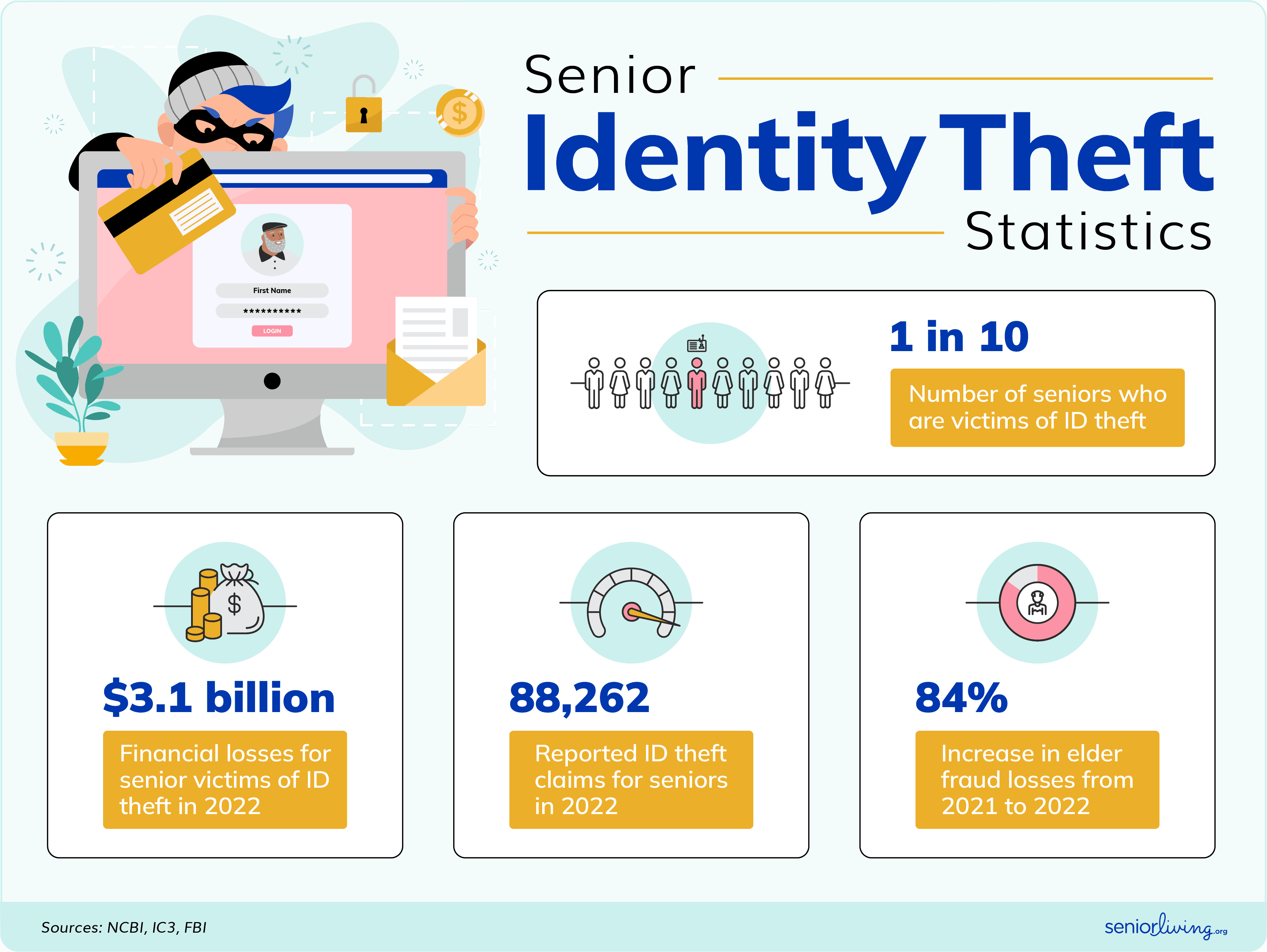
Senior Identity Theft Statistics: Key Takeaways
- One in 10 seniors is a victim of identity theft each year.
- While people age 60 and older report fewer cases of identity theft than people in their 30s, they experience greater financial loss than any other age group.
- Instances of elder fraud and identity theft have increased rapidly over the past few years.
- Some of the most common identity theft schemes targeting seniors include medical identity theft, tax fraud, and wire transfer fraud.
Identity theft can happen to anyone, but it is a major concern for older adults. In fact, identity theft of Americans age 60 and older resulted in financial losses of $3.4 billion in 2023 alone, far more than any other age group1. Identity theft among older adults can take many different forms, so it’s important to understand how seniors are affected and what can be done to prevent elder fraud and abuse in the future.
In this guide, we’ll take a closer look at the prevalence of senior identity theft and provide some of the most important facts and statistics.
Identity Theft Statistics by Age Group
As of the latest census, there are 55.8 million Americans who are 65 years of age or older2. In an average year, 1 in 10 seniors is a victim of identity theft3. This means that, on any given day, there could be more than 15,000 cases of identity theft among older adults.
It’s a common misconception that older adults are more likely to have their identity stolen than those in other age groups. While elder fraud is a very real problem, the truth is that people between the ages of 30 and 39 are more likely to experience identity theft than those in retirement. Part of the reason for the misconception is how the data is presented, as Americans in their 30s typically have fewer assets than people age 60 and older. People in their 30s are also more likely to check their credit reports and financial accounts regularly, enabling them to catch and report identity theft early on. Identity theft among older adults often takes longer to report and results in much greater financial loss.
Pro Tip: Want to stay updated on how you can keep yourself safe from scammers? Check out our guide to identity theft protection for seniors.
To get a better idea of what identity theft looks like for different age groups, here is a breakdown of identity theft based on data provided by the Federal Bureau of Investigation’s Internet Crime Report for 2023:
| Age group | Identity theft claims | Percentage of IT claims | Financial losses | Percentage of total IT losses |
|---|---|---|---|---|
| Under 20 | 18,174 | 4.33% | $40.7 million | 0.49% |
| 20 to 29 | 62,410 | 14.87% | $360.7 million | 4.40% |
| 30 to 39 | 88,138 | 21.00% | $1.2 billion | 14.63% |
| 40 to 49 | 84,052 | 20.02% | $1.5 billion | 18.29% |
| 50 to 59 | 65,924 | 15.70% | $1.7 billion | 20.73% |
| 60 and over | 101,068 | 24.08% | $3.4 billion | 41.46% |
| All age groups | 419,766 | 100% | $8.2 billion | 100% |
As you can see from the table above, adults age 60 and above accounted for 24.08 percent of all identity theft claims in 2023 and experienced about 41.46 percent of the total financial losses. So, while older adults are not necessarily more likely to become victims of identity theft, they do tend to experience far greater losses than any other age group.
Pro Tip: Stay safe by learning about the best identity theft protection services for seniors.
It’s important to point out that the data above refers only to cases of identity theft that were officially reported in 2023. Many cases of identity theft, particularly among older adults, go unreported for extended periods. This is because older adults may be less likely to monitor their financial accounts and credit reports, and may not realize they’ve been the victim of identity theft for months or even years after their data was stolen.
Most Common Types of Identity Theft Among Seniors
There are many different types of identity theft; some occur in person, while others occur virtually or over the phone. Certain types of identity theft scams specifically target seniors4. Here are some of the most common types of identity theft that happen to older adults:
- Medical identity theft: This happens when personally identifiable information (PII) is stolen and then used to bill the victim for medical services or treatments they did not receive.
- Estate identity theft: Estate identity theft occurs after a senior has passed away and someone else fraudulently collects their Social Security checks or other benefits.
- Tax fraud: If an older adult expects to receive a tax refund, someone can use their PII to steal the funds from them.
- Phone scams: Phone scams are very common and vary in both form and strategy. In some cases, a scammer may call or text an older adult and claim to be a family member or acquaintance. In other cases, the scammer may try to make the person believe that they have won a prize or are eligible for a special offer. In either case, phone scams typically seek to collect PII to allow for other kinds of financial fraud and theft.
- Military identity theft: This type of identity theft involves stealing a veteran’s PII in order to collect their military benefits.
- Wire transfer fraud: This type of fraud occurs when a scammer uses social engineering, the psychological manipulation of people, to convince us to send money under false pretences.
How Senior Identity Theft Has Evolved Over the Years
As society becomes more reliant on technology to store and transfer sensitive data and PII, it becomes harder for older adults to keep themselves protected. Sixteen percent of American adults are not digitally literate, and the rate of digital literacy tends to decline as age age increases5. This exposes many older adults to online scams, which often involve tricking or coercing the victim into giving out PII to gain access to their government benefits or bank accounts.
Many older adults are also more susceptible to cybersecurity threats, as they are less likely to change passwords, use security software, or even regularly check financial statements than younger demographics. Cyber security expert Adam Pilton notes that implementing strong fundamental controls reduces the chance of a successful attack, since scammers often look for the low hanging fruit. To ensure you are not the low hanging fruit, make sure to implement multi-factor authentication.
A greater sense of trust and lack of digital literacy can also make it easier for seniors to fall prey to scams that pop up on their phones. Email phishing has been around for years, but now SMS text phishing — known as “smishing” — has become increasingly common. Many automated texts will claim that there is an issue with a purchase, financial transaction, or package delivery to encourage the recipient to click on a suspicious link and voluntarily provide their PII6.
While the internet might have made identity theft easier for perpetrators, identity theft has been around for a long time and doesn’t always occur remotely. Even today, many cases of identity theft are carried out in person. For example, a pickpocket may steal someone’s wallet and use their identification to take out loans or lines of credit. Seniors tend to be at higher risk of this kind of fraud, as they may carry their Social Security number or Medicare card on their person.
Regardless of the methods used to carry out these crimes, the latest data indicates that identity theft and elder fraud are on the rise. According to the 2021 Elder Fraud Report, losses from elder fraud increased by 74 percent between 2020 and 20217; losses from elder fraud increased by an additional 84 percent between 2021 and 20228.
While elder fraud and senior scams are prevalent, there are many ways to avoid them and protect your identity. Watch our video below with Eric Olsen, Executive Director of the HELPS Nonprofit Law Firm, and Jeff Hoyt, SeniorLiving.org Editor-in-Chief, to learn more.
Frequently Asked Questions About Senior Identity Theft
-
Why are older adults more susceptible to identity theft?
There are many reasons older adults are more susceptible to identity theft. It is most often because seniors tend to be more trusting than younger adults and have more assets and credit at their disposal.
-
What is the No. 1 cause of identity theft?
Data breaches are one of the most common causes of identity theft, in part because they allow hackers to access the personally identifiable information of hundreds or even thousands of individuals at a time.
-
Can Social Security help with identity theft?
No, Social Security cannot help if your SSI has been stolen or involved in fraud. Instead, it is recommended that you file a report with IdentityTheft.gov and work with your banking institution to resolve any fraudulent charges.
-
What types of accounts are most susceptible to identity theft?
Credit card fraud is one of the most common types of identity theft, as it can be easier to carry out and gives the perpetrators instant access to funds. That said, any type of account that holds financial value is susceptible to identity theft and fraud.
-
How can I help my senior with identity theft?
If you want to help a loved one protect themselves against identity theft, you should regularly go over their financial statements with them and help ensure that they use the best practices when it comes to online security.
Looking for data or expertise to support your work? See our open data portal, or reach out to us at open-data@seniorliving.org to connect with an expert on aging in America.
-
FBI. (2023). Internet Crime Report.
-
United States Census Bureau. (2020). 2020 Census: 1 in 6 People in the United States Were 65 and Over.
-
National Library of Medicine. (2020). Identity Theft Among Older Adults: Risk and Protective Factors.
-
U.S. Department of Education. (2018). A Description of U.S. Adults Who Are Not Digitally Literate.
-
AARP. (2023). Smishing.
-
Justice.gov. (2021). Elder Fraud Report.
-
FBI. (2023). FBI Springfield Warns Elder Fraud Continues to Be a Growing Problem.