Cities With the Most Working Seniors in 2026

Key Findings
- Today, nearly 1 in 5 Americans aged 65+ are working, driven by longer life expectancy, flexible jobs, and rising living costs. In 2000, just 13% of older adults were in the workforce.
- The U.S. metros with the highest share of adults aged 65 and older still in the workforce are Bridgeport–Stamford–Danbury, CT (27.5%), Washington, D.C. (25.4%), Midland, TX (25.2%), Boston-Cambridge-Newton, MA (24.8%), and Santa Rosa-Petaluma, CA (24.7%).
- Crossing guards, school bus and other vehicle drivers, clergy, and psychologists have some of the oldest workforces. More than 1 in 5 workers in these fields are aged 65 or older.
- 38% of working seniors say they need to work to make ends meet. Quality-of-life factors, such as staying busy (34%) and maintaining social connections (24%), are also key motivators for working past retirement age.
- 15% of adults 65+ who are currently retired are considering returning to paid work in the near future.
Today, nearly one in five Americans aged 65 and older remains in the workforce, a figure that reflects profound shifts in how Americans approach their later years. Americans are living longer, healthier lives, with many maintaining the physical and cognitive capacity to work well into their seventies. The rise of flexible work arrangements and part-time professional roles has made it easier for older adults to remain economically active on their own terms.
Meanwhile, rising costs for housing, healthcare, and lifestyle expenses have complicated traditional retirement planning, making continued income more attractive or necessary. According to the U.S. Bureau of Labor Statistics, the workforce participation rate among adults 65 and older is projected to increase further by 2030.
To determine which U.S. cities have the most working seniors and why people are working well into their golden years, we analyzed data from the American Community Survey and surveyed nearly 1,000 adults aged 65 or older.
Which U.S. Cities Have the Most Working Seniors in 2026?
Since the 1980s, the percentage of older Americans in the workforce has steadily increased. Decades of declining workforce participation rates reached a low in 1985, when 10.8 percent of people aged 65 or older were working or actively seeking work. Today, that figure has risen to 19.5 percent. However, particular areas have higher-than-average concentrations of senior workers.
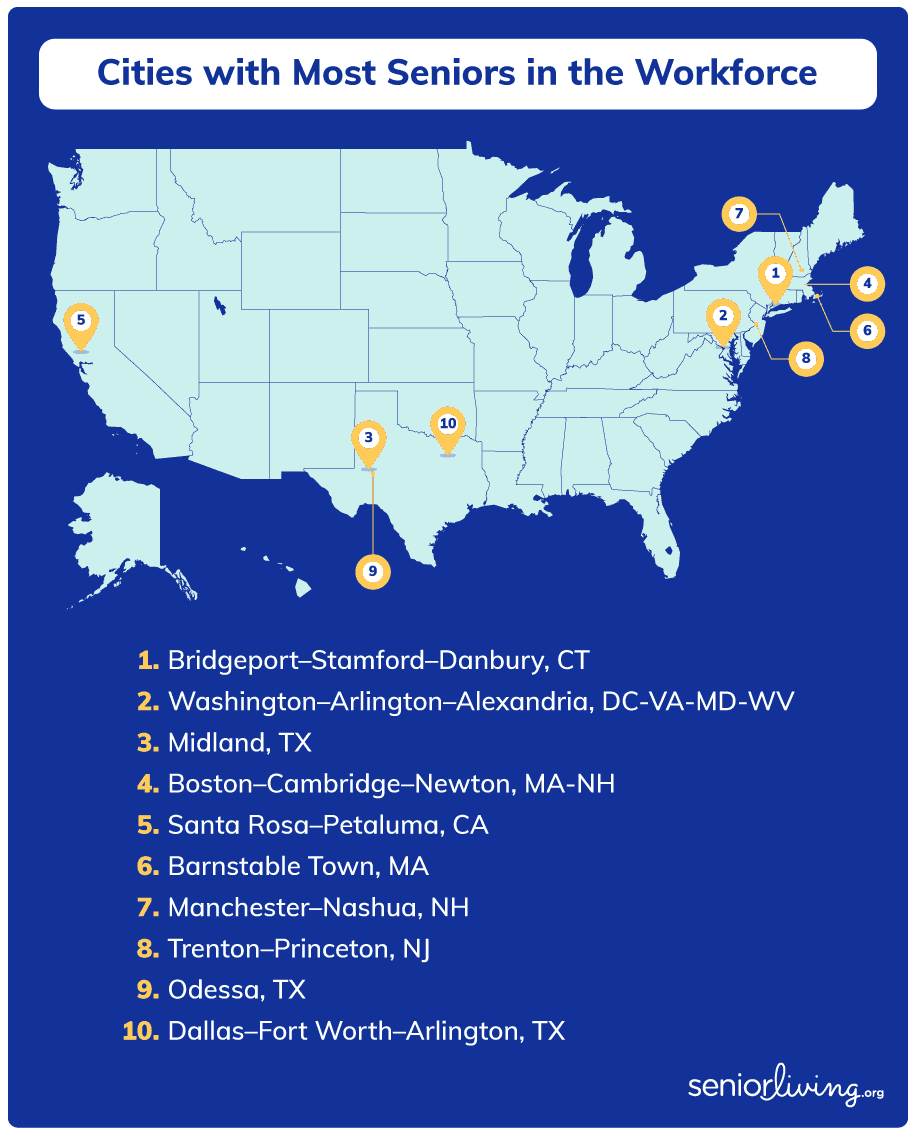
Several areas across the country exceed the national senior employment rate by six to nine percentage points. High senior employment rates are found in both large metros like Washington, D.C., and Boston, as well as in smaller labor-constrained markets like Midland and Lawrence. Notably, income levels in these top metros suggest work is often optional rather than desperation-driven, with most showing median household incomes above $60,000 for seniors.
Metropolitan Areas With the Highest Share of Seniors (65+) in the Workforce
| Metropolitan area | Percent of people 65+ in workforce | Total 65+ population | Median household income (65+) |
|---|---|---|---|
| Bridgeport–Stamford–Danbury, CT | 27.5% | 157,181 | $79,064 |
| Washington–Arlington–Alexandria, DC-VA-MD-WV | 25.4% | 870,390 | $92,624 |
| Midland, TX | 25.2% | 18,801 | $55,925 |
| Boston–Cambridge–Newton, MA-NH | 24.8% | 818,502 | $69,584 |
| Santa Rosa–Petaluma, CA | 24.7% | 101,805 | $77,597 |
| Barnstable Town, MA | 24.3% | 74,234 | $77,653 |
| Manchester–Nashua, NH | 24.3% | 71,059 | $65,260 |
| Trenton–Princeton, NJ | 24.3% | 60,012 | $67,139 |
| Odessa, TX | 23.6% | 16,038 | $41,096 |
| Dallas–Fort Worth–Arlington, TX | 23.5% | 926,073 | $64,220 |
| Lubbock, TX | 23.4% | 47,495 | $50,130 |
| Santa Cruz-Watsonville, CA | 23.4% | 48,784 | $84,758 |
| Champaign-Urbana, IL | 23.3% | 34,070 | $63,270 |
| Atlantic City-Hammonton, NJ | 22.9% | 80,121 | $65,089 |
| Lincoln, NE | 22.9% | 51,337 | $64,502 |
| New Haven, CT | 22.6% | 103,124 | $66,136 |
| Denver-Aurora-Centennial, CO | 22.4% | 411,553 | $71,021 |
| Baltimore-Columbia-Towson, MD | 22.2% | 463,838 | $67,448 |
| Worcester, MA | 22.2% | 142,716 | $59,544 |
| Houston-Pasadena-The Woodlands, TX | 22.1% | 875,814 | $60,992 |
| Salt Lake City-Murray, UT | 22.1% | 144,069 | $69,748 |
| New York-Newark-Jersey City, NY-NJ | 22.0% | 3,277,815 | $64,810 |
| Austin-Round Rock-San Marcos, TX | 22.0% | 275,465 | $73,233 |
| Provo-Orem-Lehi, UT | 22.0% | 54,755 | $76,092 |
| Portland-South Portland, ME | 22.0% | 116,229 | $61,821 |
Source: 2024 American Community Survey (U.S. Census Bureau, U.S. Department of Commerce)
A Closer Look at the Top 5 Cities
1. Bridgeport-Stamford-Danbury, CT
This Connecticut metro ranks first in the nation for the highest percentage of seniors still in the workforce. Out of a total senior population of 157,181, about 43,225 are employed or seeking jobs—a labor force participation rate of more than one in four seniors (27.5%).
The region's extremely high cost of living, particularly for housing and property taxes, plays a role, but the story is more nuanced than just financial pressure.
| Top occupations among 65+ residents | Top industries among 65+ residents |
|---|---|
| Managers | Elementary and secondary schools |
| Registered nurses | Construction |
| Lawyers and judges | General medical and surgical hospitals |
| Accountants and auditors | Management consulting |
| Shipping, receiving, and inventory clerks | Legal services |
Source: 2024 American Community Survey (U.S. Census Bureau, U.S. Department of Commerce)
The occupational profile reveals a highly professional senior workforce. The area's large concentration of finance, professional services, and consulting jobs offers part-time work and remote or flexible schedules, allowing seniors to remain engaged on their own terms. Many seniors maintain high incomes but face correspondingly high expenses. The pattern suggests that affluent seniors choose to stay attached to high-paying, flexible jobs to maintain their lifestyle rather than work out of necessity.
2. Washington-Arlington-Alexandria, DC-VA-MD-WV
This massive metropolitan area demonstrates the clearest example of career longevity rather than financial stress. With 221,079 seniors in the workforce—more than one in four of the region's 870,390 seniors—the nation's capital shows how institutional knowledge remains highly valued.
| Top occupations among 65+ residents | Top industries among 65+ residents |
|---|---|
| Managers | Elementary and secondary schools |
| Lawyers and judges | General medical and surgical hospitals |
| Registered nurses | Construction |
| Postsecondary teachers | Management consulting |
| Management analysts | Legal services |
Source: 2024 American Community Survey (U.S. Census Bureau, U.S. Department of Commerce)
Industry data reveals the massive concentration of federal contractors, policy work, and consulting in the DMV region, which it is known for. This creates a strong culture of late retirement where seniors possess specialized expertise and institutional memory that organizations actively seek to retain. With a median household income of $92,624 for seniors—the highest among top metros—this workforce participation clearly reflects choice and career satisfaction rather than economic necessity.
3. Midland, TX
Despite having one of the smallest senior populations among top metros at just 18,801, 25.2 percent of Midland's seniors are in the workforce. The occupational profile here is strikingly different from that of coastal metros and is known for its booming oil and gas industry and agricultural sector.
| Top occupations among 65+ residents | Top industries among 65+ residents |
|---|---|
| Farmers, ranchers, and agricultural managers | Animal production and aquaculture |
| Office clerks | Support activities for mining |
| Construction managers | Automotive repair and maintenance |
| Automotive service technicians | Construction |
| Secretaries and administrative assistants | Elementary and secondary schools |
Source: 2024 American Community Survey (U.S. Census Bureau, U.S. Department of Commerce)
Farmers, ranchers, and agricultural managers represent a remarkable 11 percent of the senior workforce—by far the highest concentration in any occupation. For many, farming and ranching are more than jobs; they are lifestyles that keep people engaged in their work well into their lives.
Another seven percent of 65-plus workers in Midland work in the automotive repair industry. Automotive workers have skills that have remained in high demand for decades, creating solid job security, especially in an oil-producing region where many support vehicles are required. Additionally, unlike some physically demanding factory roles, automotive repair work can sometimes be adapted as workers age.
4. Boston-Cambridge-Newton, MA-NH
With 202,988 seniors working (nearly one in four in the metropolitan area), Boston exemplifies how knowledge-based economies support extended careers. The region is home to several world-renowned universities, healthcare systems, and research institutions, which create abundant opportunities for seniors to work part-time as adjuncts, researchers, clinicians, or consultants.
| Top occupations among 65+ residents | Top industries among 65+ residents |
|---|---|
| Managers | Construction |
| Postsecondary teachers | General medical and surgical hospitals |
| Lawyers, judges, and magistrates | Automotive repair and maintenance |
| Registered nurses | Junior colleges, colleges, universities, and professional schools |
| Chief executives and legislators | Elementary and secondary schools |
Source: 2024 American Community Survey (U.S. Census Bureau, U.S. Department of Commerce)
The highly educated senior population in this metro naturally follows longer career trajectories, with many professionals in academia, medicine, and research maintaining active roles well past traditional retirement age. The median household income of $69,584 for seniors supports the interpretation that these are engagement-driven choices.
5. Santa Rosa-Petaluma, CA
Rounding out the top five, Santa Rosa demonstrates a mixed picture with 25,146 seniors in the workforce (24.7 percent of the 65-plus population). Very high housing costs in this Northern California wine country region create pressure for workers, but the nature of work tells a more complex story.
| Top occupations among 65+ residents | Top industries among 65+ residents |
|---|---|
| Management analysts | Lessors of real estate, and offices of real estate agents and brokers |
| Real estate brokers and sales agents | Construction |
| Other managers | Elementary and secondary schools |
| Chief executives and legislators | Management, scientific, and technical consulting services |
| Retail supervisors | Individual and family services |
Source: 2024 American Community Survey (U.S. Census Bureau, U.S. Department of Commerce)
Many seniors in Santa Rosa are self-employed or work in real estate, consulting, and service sectors. This work may supplement retirement income to offset cost-of-living pressure. Still, it also often represents lifestyle choices, managing properties, consulting, or working in roles that offer autonomy and flexible schedules, that blend income generation with personal fulfillment.
Which Jobs Have the Highest Share of Workers Age 65 and Older?
At the national level, different occupations emerged as the most popular among older workers, revealing which jobs best attract seniors or rely most heavily on their experience.
Occupations with the oldest workforces tend to offer part-time schedules, community engagement, or rely heavily on experience rather than physical labor. These include crossing guards, school bus drivers, clergy, psychologists, tax preparers, and musicians.
Top 20 Occupations by Percent of Workers Who Are 65+
| Occupation | Percent in workforce aged 65+ |
|---|---|
| Crossing guards and flaggers | 32.0% |
| School bus monitors | 26.5% |
| Bus drivers, school | 26.5% |
| Motor vehicle operators, all other | 24.3% |
| Shuttle drivers and chauffeurs | 22.9% |
| Other psychologists | 22.4% |
| Clergy | 22.0% |
| Musicians and singers | 22.0% |
| Tailors, dressmakers, and sewers | 21.8% |
| Tax preparers | 21.8% |
| Clinical and counseling psychologists | 21.0% |
| Proofreaders and copy markers | 20.7% |
| Models, demonstrators, and product promoters | 20.3% |
| Farmers, ranchers, and other agricultural managers | 19.4% |
| Religious workers, all other | 19.4% |
| Morticians, undertakers, and funeral arrangers | 18.3% |
| Bus drivers, transit and intercity | 17.6% |
| Travel agents | 17.6% |
| Passenger attendants | 17.5% |
| Switchboard operators | 17.0% |
Source: 2024 American Community Survey (U.S. Census Bureau, U.S. Department of Commerce
Crossing guards represent the most senior-dominated occupation in the United States, with nearly one in three workers aged 65 or older. Transportation, education-adjacent, and trust-based roles dominate the top of the list, rewarding experience and reliability more than physical intensity and making them well-suited to older workers.
Psychology and clergy positions reflect careers where accumulated wisdom and life experience become assets rather than liabilities. Additionally, fewer young adults are religious today than in past decades, thus leading to an aging workforce in churches. Creative professions, such as musicians and models, also offer flexibility for older professionals who want to maintain their skills and hobbies while earning income.
Why Are Seniors Working Longer?
According to our own survey of nearly 1,000 adults aged 65+, there are a variety of reasons older adults stay in the workforce past the traditional retirement age. Survey data revealed 38 percent of working seniors need the income to cover basic costs—and financial need drives many seniors back to work across the country. Many also cite staying busy, maintaining routine, and social connection as equally important motivations.
Among those ages 65–69 in our study, only half are fully retired, while 27 percent are partially retired, 20 percent have never retired, and four percent have returned to work after retiring. This flexibility represents a dramatic shift from previous generations' approach to retirement as a one-time, permanent transition.
Retirement Status Among Adults 65+
| Status | 65–69 | 70+ | All 65+ |
|---|---|---|---|
| Fully retired | 50% | 64% | 57% |
| Partially retired | 27% | 22% | 25% |
| Never retired | 20% | 10% | 15% |
| Formerly retired | 4% | 3% | 3% |
Source: 2026 SeniorLiving.org survey
Interestingly, the survey reveals quality-of-life motivations rival financial ones. While 67 percent work for extra spending money and 38 percent need to stay employed to cover basic living costs, non-financial reasons dominate much of the picture. Staying busy, avoiding boredom, maintaining routine, and social connections collectively show that work provides structure, purpose, and community.
Key Reasons for Working After Retirement
| What are your reasons for continuing to work? | Percent of respondents |
|---|---|
| Earn some spending money | 67% |
| Keep busy | 43% |
| Cover basic living costs | 38% |
| Avoid boredom | 34% |
| Pay off debt | 28% |
| Maintain routine | 27% |
| Social connection | 24% |
| Support family | 14% |
| Start or grow business | 13% |
| Afford healthcare | 10% |
Source: 2026 SeniorLiving.org survey
Most seniors consider how work affects their Social Security benefits, but few let these considerations stop them from working. Only 16 percent report that work has a strong influence on their benefits decisions, while 42 percent considered the issue but found it had no impact on their decision to work. For many considering a return to the workforce after collecting Social Security, seeking guidance from a financial advisor can prevent unnecessary penalties or complications. Understanding the tax deductions available to seniors can also help maximize take-home income.
What This Means for Retirement in the U.S.
The data paints a clear picture: retirement is evolving from a fixed destination to a flexible journey. With nearly one in five Americans aged 65+ still working and that number projected to grow, employers, policymakers, and families must adapt to this new reality.
Looking ahead, the trend shows no signs of slowing. Among older adults who are not currently working, 15 percent are considering returning to paid work. This “unretirement pipeline” suggests future retirees are already planning longer, more flexible work lives.
The geographic concentration of working seniors in affluent metropolitan areas suggests that for many, continued employment represents choice and engagement rather than economic desperation. The occupations that have the most seniors—such as crossing guards and psychologists—are often roles that value experience, reliability, and wisdom.
As Americans continue to live longer, healthier lives, the boundary between work and retirement will grow even more fluid. Understanding where seniors work, what jobs they choose, and why they remain engaged provides crucial insights for anyone planning their own later years or supporting older adults in their lives.
Data Sources & Credibility
This analysis is based on 2021–2024 American Community Survey (U.S. Census Bureau) microdata and a nationally representative 2026 SeniorLiving.org survey of 996 adults aged 65+, conducted at a 95% confidence level.
American Community Survey Analysis
For this report, we analyzed 2021–2024 American Community Survey (ACS) microdata and applied official Person Weights to ensure nationally representative results. We first examined the labor force participation rate among adults 65+, capturing those working or actively seeking work.
To assess work intensity, we calculated average weekly hours and weeks worked per year, combining them to estimate total annual hours and distinguish full-time from supplemental employment. Finally, we localized the data to identify senior employment hotspots among U.S. metropolitan areas with populations of 150,000 or more people.
SeniorLiving.org Survey
In addition to analyzing data from the ACS, we conducted a cross-sectional online survey designed to collect self-reported data from older adults in the United States. The study focused exclusively on individuals aged 65 and older. A total of 996 participants completed the survey. The sample was intentionally balanced by sex, resulting in an equal proportion of male and female respondents.
Data collection took place online between December 19, 2025, and January 8, 2026. The survey was self-administered, and only fully completed questionnaires from eligible participants were retained for analysis. Responses that did not meet completion or eligibility requirements were excluded to preserve data integrity. The results are reported at a 95% confidence level and have an estimated margin of error of approximately ±3.1 percentage points for the full sample.